Monday, October 30, 2006

Is Predestination Fatalism?
IS PREDESTINATION FATALISM?

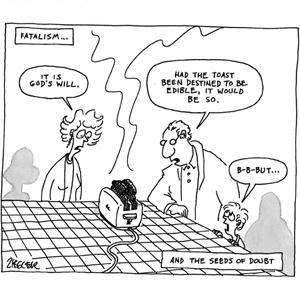
A frequent objection raised against predestination is that it is a religious form of fatalism. If we examine fatalism in its literal sense we see that it is as far removed from the biblical doctrine of predestination as the East is from the West. Fatalism literally means that the affairs of men are controlled either by whimsical sub-deities (the Fates) or more popularly by the impersonal forces of chance.
Predestination is based neither on a mythical view of goddesses playing with our lives nor upon a view of destiny controlled by the chance collision of atoms. Predestination is rooted in the character of a personal and righteous God, a God who is the sovereign Lord of history. That my destiny would ultimately be in the hands of an indifferent or hostile force is terrifying. That it is in the hands of a righteous and loving God is quite another matter. Atoms have no righteousness in them; they are at best amoral. God is altogether holy. I prefer that my destiny be with him.
The great superstition of modern times is focused on the role given to chance in human affairs. Chance is the new reigning deity of the modern mind. Chance inhabits the castle of the gods. Chance is given credit for the creation of the universe and the emergence of the human race from the slime.
Chance is a shibboleth. It is a magic word we use to explain the unknown. It is the favorite power of causality for those who will attribute power to anything or anyone but God. This superstitious attitude toward chance is not new. We read of its attraction very early in biblical history.
We remember the incident in Jewish history when the sacred Ark of the Covenant was captured by the Philistines. On that day death visited the house of Eli and the Glory departed from Israel. The Philistines were jubilant over their victory, but they soon learned to rue the day. Wherever they took the Ark calamity befell them. The temple of Dagon was humiliated. The people were devastated by tumors. For seven months the Ark was shuttled between the great cities of the Philistines with the same catastrophic results in each city.
In desperation the kings of the Philistines took counsel together and decided to send the Ark back to the Jews with a ransom as well, to mollify the wrath of God. Their final words of counsel are noteworthy:

Then take the ark of the LORD and set it on the cart; and put the articles of gold which you are returning to Him as a trespass offering in a chest by its side. Then send it away, and let it go.
And watch: if it goes up the road to its own territory, to Beth Shemesh, then He has done us this great evil. But if not, then we shall know that it is not His hand that struck us; it was by chance that it happened to us (1 Samuel 6:8, 9).

We have already noted that chance can do nothing because it is nothing. Let me elaborate. We use the word chance to describe mathematical possibilities. For example, when we flip a coin we say that it has a fifty/fifty chance to come up heads. If we call heads on the toss and it turns up tails, we might say that our luck was bad and that we missed our chance.
How much influence does chance have on the toss of a coin? What makes the coin turn up heads or tails? Would the odds change if we knew which side the coin started on, how much pressure was exerted by the thumb, how dense the atmosphere was, and how many revolutions the coin made in the air? With this knowledge, our ability to predict the outcome would far exceed fifty/fifty.
But the hand is faster than the eye. We can’t measure all these factors in the normal tossing of the coin. Since we can reduce the possible outcome to two, we simplify matters by talking about chance. The point to remember, however, is that chance exercises absolutely no influence on the coin toss. Why not? As we keep saying, chance can do nothing because it is nothing. It is no thing. Before something can exert power or influence it must first be something. It must be some kind of entity, either physical or nonphysical. Chance is neither. It is merely a mental construct. It has no power because it has no being. It is nothing.
To say that something has happened by chance is to say that it is a coincidence. This is simply a confession that we cannot perceive all the forces and causal powers that are at work in an event. Just as we cannot see all that is happening in a coin toss with the naked eye, so the complex affairs of life are also beyond our exact ability to penetrate. So we invent the term chance to explain them. Chance really explains nothing. It is merely a word we use as shorthand for our ignorance.
I recently wrote on the subject of cause and effect. A professor of philosophy wrote to me complaining of my naive understanding of the law of cause and effect. He chided me for failing to take into account “uncaused events.” I thanked him for his letter and said that I would be happy to grapple with his objection if he would write back and provide just one example of an uncaused event. I am still waiting. I will wait forever because even God cannot have an uncaused event. Waiting for an uncaused event is like waiting for a square circle.
Our destinies are not controlled by chance. I say that dogmatically with all the bluster I can manage. I know that my destiny is not controlled by chance because I know that nothing can be controlled by chance. Chance can control nothing because it is nothing. What are the chances that the universe was created by chance or that our destinies are controlled by chance? Not a chance.
Fatalism finds its most popular expression in astrology. Our daily horoscopes are compiled on the basis of the movements of the stars. People in our society know more about the twelve signs of the zodiac than they do about the twelve tribes of Israel. Yet Reuben has more to do with my future than Aquarius, Judah more than Gemini.

HT: R.C. Sproul

Sunday, October 29, 2006

John Calvin on Christian Liberty

Christian Liberty is a matter of primary necessity, one without the knowledge of which the conscience can scarcely attempt any thing without hesitation, in many must demur and fluctuate, and in all proceed with fickleness and trepidation. In particular, it forms a proper appendix to Justification, and is of no little service in understanding its force. Nay, those who seriously fear God will hence perceive the incomparable advantages of a doctrine which wicked scoffers are constantly assailing with their jibes; the intoxication of mind under which they labour leaving their petulance without restraint. This, therefore, seems the proper place for considering the subject.

Click here for full article.

The Holy, Hellish, Hodgepodge History of Halloween


Gimme some sugar, baby


It’s the time of year when leaves die and trees turn to skeletons. The garden stops providing. An evening stroll changes from bright sun and chirping birds to dark night and the howling wind. As Halloween approaches, the fact that we begin to consider death and ghost stories is not inherently pagan. It’s human. It’s what we do with those thoughts that matters.

A recent thread on our Mars Hill Members’ Site raised the perennial issue of Halloween and whether Christians should observe this holiday. More to the point, most Christians do observe it, but differ in the level of participation or acceptance of it. Evangelist Jack Chick, for instance, the man famous for “Chick Tracts” depicts Halloween as a night when ancient Celtic Druids raped and sacrificed virgins, leaving carved pumpkins on the doorsteps of households that gave up their daughters (never mind the fact that pumpkins were a New World plant exported and only grown in Europe recently). Other Christians offer the opposite but equally naïve defense of “it’s no big deal”, sending their kids out to eat candy and legitimize American obesity statistics.

Click here for full article.

LA Times Columnist Joel Stein: Christianity Is A 'Death Cult'

An October 17, 2006, op-ed by Los Angeles Times columnist Joel "I Don't Support Our Troops" Stein condescendingly slams Christianity as a "death cult."

Writing a lippy account of a Presbyterian service he had recently attended, Stein belches,

"The first thing I noticed about church was how much like PBS it was. The lighting was dim, the speakers talked slowly, the songs were dated, there were a lot of references to reading material and every so often my eye line was interrupted by envelopes asking me to donate money. Also, I kept falling asleep."

And (bold added),

"I'd never realized how much of a death cult Christianity is. When we weren't fixating on how awesome Christ's murder was, we were singing about how terrific it was going to be when we bite it. Chipper up, Christians! There's a lot to live for. They're making more of those 'Narnia' movies."

For full article click here.

Survey Dispels Conservative Evangelical Stereotypes

A new Baylor Religion Survey contradicted commonly held views about Evangelical Christians and their political, social and cultural views, which are stereotyped as conservative.

The survey found a large number of evangelicals holding liberal views on certain matters while maintaining conservative views on such issues as abortion and gay marriage. Conversely, many nonevangelicals were found to hold not just liberal views on some cultural issues.

For full article click here.

Out of the Pews, into the Pantries

Worshippers at Bent Tree Bible Fellowship in Carrollton walked out early two Sundays ago – at Pastor Pete Briscoe's insistence.

He ended all four worship services half an hour early, encouraging the 2,345 total attendees to go to a grocery store and bring back items for three local food pantries.

The gambit met with fishes-and-loaves success: Church members collected 24 tons of food, with a focus on the pantries' requests for canned goods, peanut butter, toilet paper and a few other items.

Mr. Briscoe said the exercise had a great practical benefit, but also helped the congregation focus on the needs of the poor. Pantry personnel were elated.

"It was more than astonishing. This was the biggest food drive we've ever had a church do," said Maureen Cummings, director of food and seasonal programs at Christian Community Action in Lewisville, which got more than 10 tons of relief items. "We were completely out of canned vegetables, and we were desperate. This truly was an answer."

Click here for full article.

Former Bush Assistant: GOP Deceived Christians

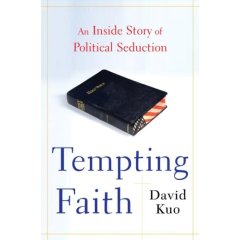
David Kuo is the author of Tempting Faith, a book about why he left his job as a special assistant to President Bush in the Office of Faith Based Initiatives. Kuo criticizes the administration for taking unfair advantage of conservative Christian voters.

Linda Wertheimer talks to Kuo about why he concluded that President Bush and the Republican Party have deceived conservative Christians.

Click here to LISTEN to full story.

Go Bible Go!


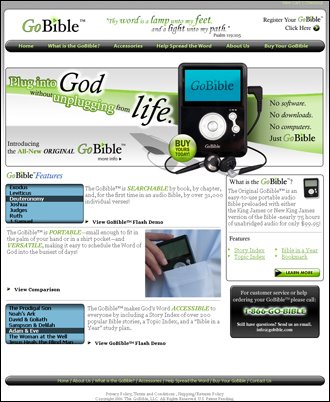
Several technology companies have for years served the Christian community with electronic versions of the Bible, typically in the form of portable text scrolling devices. But for the first time ever, the entire Bible is available in audio format from a single dedicated handheld device, the new Original GoBible.

(PRWEB via PRWeb) October 25, 2006 – The community of more than 200,000 Christians in the United States has largely embraced the fusion of new technology and Biblical teachings that has increased in scope for more than a decade. Interactive computer software, Bible readings on CD and even electronic handheld devices with the complete Bible text have generated renewed interest, assisted Christians with disabilities and provided time-saving solutions for multitasking situations. But a complete audio Bible contained in a single portable handheld device has only recently become available, opening up a whole new method of on-the-go learning and audio Bible study.

For full article click here.

Half of Evangelicals Oppose Funding of Religious Groups

WASHINGTON - Half of the nation's evangelical Christians do not support government funding of faith-based organizations, a survey shows.

New data released Wednesday (Oct. 25) from the Baylor Religion Survey show that 50 percent of evangelicals, and 65 percent of the total population, think federal funding of religious organizations is inappropriate. Twenty-six percent of the total respondents surveyed said they agree with such funding.

Byron Johnson, a sociology professor at Baylor University, said the finding about evangelicals may be the product of misinformation and rumors about the work of faith-based initiatives.

"For example, a lot of groups will not even entertain the idea of applying for public funds because they feel like if they do that the cross or the menorah or the Star of David has to come down," he said. "I think it reflects a horrible miscommunication about the initiative."

For full article click here.

Saturday, October 28, 2006

Don't Miss Out On A Blessing

Why is it that God rescues some people from hell and not others? Honestly I don't know why some are and others are not, but I do know that it is to His glory that some are saved. Who are we to question God? He will have compassion on whom He will have compassion on and mercy on whom He will have mercy. It is His decision who He will save, my friends. Remember He is a good and gracious God. Praise, glory and honor due His name! As a saved individual you are a precious jewel to God and He chose to save you to be with Him one day in Heaven; do me a favor and pray for those who are not yet saved because they may be one day.

This is a GREAT devotion this morning from CH Spurgeon and worth sharing, I hope you enjoy it!

"I have chosen you out of the world."John 15:19

Here is distinguishing grace and discriminating regard; for some are made the special objects of divine affection. Do not be afraid to dwell upon this high doctrine of election. When your mind is most heavy and depressed, you will find it to be a bottle of richest cordial. Those who doubt the doctrines of grace, or who cast them into the shade, miss the richest clusters of Eshcol; they lose the wines on the lees well refined, the fat things full of marrow. There is no balm in Gilead comparable to it. If the honey in Jonathan's wood when but touched enlightened the eyes, this is honey which will enlighten your heart to love and learn the mysteries of the kingdom of God. Eat, and fear not a surfeit; live upon this choice dainty, and fear not that it will be too delicate a diet. Meat from the King's table will hurt none of His courtiers. Desire to have your mind enlarged, that you may comprehend more and more the eternal, everlasting, discriminating love of God. When you have mounted as high as election, tarry on its sister mount, the covenant of grace. Covenant engagements are the munitions of stupendous rock behind which we lie entrenched; covenant engagements with the surety, Christ Jesus, are the quiet resting-places of trembling spirits.
"His oath, His covenant, His blood,Support me in the raging flood;When every earthly prop gives way,This still is all my strength and stay."
If Jesus undertook to bring me to glory, and if the Father promised that He would give me to the Son to be a part of the infinite reward of the travail of His soul; then, my soul, till God Himself shall be unfaithful, till Jesus shall cease to be the truth, thou art safe. When David danced before the ark, he told Michal that election made him do so. Come, my soul, exult before the God of grace and leap for joy of heart.

Thursday, October 26, 2006

Christ and Halloween

I have been forced into a bi-vocational pastorate while I have been at the First Baptist Church of Burden, Ks for the last five years. This small town does not offer much in the way of outside employment, but I have found bus/van driving for the school and substitute teaching to work well with my schedule and besides it is extra income for my family. In many ways it has been a blessing to be a part-time pastor.

This week I have been substituting at Central High School of Burden. Once again, I am amazed at how much these kids look forward to the over-rated holiday of Halloween. I don't think it is just to ring doorbells and say trick or treat either. It is far more than that! I just had a talk with a student about light and darkness awhile ago. Since I have been at the school most of the week the kids have had to write papers and assignments on Halloween, so obviously that is what many are focusing on.

I always enjoy being in the classroom because being a small high school they all know I am a pastor at the Baptist church. It has really worked to my advantage. It makes for great conversations with the kids especially at this time of the year.

As a result of my conversations with teenagers, I am once again reminded of the importance of a youth ministry in the local church. As you know there is much out there in the world, Satan is out to take our children. The church has a wonderful opportunity to shine the light of Jesus Christ to our kids. Let's don't forget about them.

I am linking a great article by John MacArthur dealing with Christians and Halloween.

Tuesday, October 24, 2006

Peace and Tranquality In The Home

I don't know about you, but when my wife and I have an argument I am not that productive until we make up; especially in the area of studying God's Word and writing sermons. A key factor in marriage relationships is that it is important for men and women to live according to the proper roles as outlined in the Bible.

A friend of mine named Chris Humphreys wrote an article. It is to good not to post for the world to see. It sounds humorous at times, especially near the bottom, but for the most part I think it is a good formula to live a marriage relationship by.

A good friend of mine sent to me recently some directives from the pen of the popular Puritan preacher Richard Baxter about how husbands and wives can strengthen their relationship between themselves under the Lord. It is very good food for thought and action, and there is no way I can outdo or outsay what Baxter has written, but I wanted to share with people my simple three ideas for maintaining peace and tranquility in the home. This is repetitive stuff, but when you get old like me, one repeats himself a lot. When you get old like me, one repeats himself a lot.I've been to many marriage enrichment conferences in the past, and some were beneficial and some were not. Since I operate by the KISS principle (keep it simple, saint), I've reduced all marriage advice down to three easy-to-remember three-worded sentences. This is written with husbands in mind, since I am one. I need to remind myself of these three sentences, because they are always relevant, and because my wife's birthday is fast approaching. Husbands need to say these three sentences all the time, but there are some annual markers that keep us on our toes even more so, like the wife's birthday, Valentine's Day, the anniversary, Christmas, etc.Here we go. The first sentence that all husbands need to say to their wives all the time is:1. "I LOVE YOU." Now it is just as important to know when and how to say it. In other words, it probably is not a good idea to say those words with your head buried in the newspaper or magazine. For some reason, wives like eye contact. It is probably not a good idea also to say it at halftime when your team is ahead by four touchdowns. It would be a good practice to plant a kiss on her, hug her and say these words when your team is down by four touchdowns at halftime. And in cases like that, it is okay for a grown man to cry at the same time.You have to say those words on a daily basis on various times during the day. And you have to really, really mean it. After all, we are told in the Good Book that husbands are to love their wives as Christ loved the church. And as we read the Good Book, we see that God has told us on numerous occasions how much He has loved us.Don't fall into the trap that many husbands fall into when they think to themselves, "Well, my woman knows I love her. I don't need to say all that romantic mush. She knows that I love her by all the things I do for her. After all, I bought her a toaster last Valentine's Day, didn't I? And besides that, last week I picked up my dirty underwear and socks at least three times and put them in the dirty clothes hamper. And just yesterday, while she was freaking out in the kitchen, I bravely went in there and killed the spider for her. What more does she want?"We need to say those three words: "I love you." You might be surprised how far that will get you, husband friend.2. "I WAS WRONG." Again, it is just as important to know when and how to say it. If you only say it half- heartedly when you want a fight to end, and you want to wave the white flag of surrender, then your motivation is out of whack, and wives can pick up on those things. Or combining this sentence with the first sentence above, if about the only time you embrace her wife and say "I love you" is after you have done something terribly wrong or stupid, then wives can somehow put two and two together. She may give you that piercing glance after you say "I love you", and begin to ponder and ask, "Okay, what did you do or forget to do this time?""I was sorry" won't cut it. There is a big difference between saying that you are sorry and admitting a grievous wrong on your part. "I am sorry" carries too much unsaid baggage with it that wives again can pick up on. For example, "I am sorry. . .(that you are making a mountain out of a molehill.)" Or, "I am sorry. . .(that I ever brought up the subject.)" Or, "I am sorry. . .(that you don't see things my way, which is the only way.)" You get the drift. "I am sorry" is too overused and underappreciated.Instead, you should say, "I was wrong." To say those three words have to involve a lot of pride swallowing, which is hard for a man to do, but very necessary at times. Again, the Good Book talks a lot about how God gives grace to the humble, but He resists the proud. If a husband is not known for saying for those three words, then it might be good practice for him to stand in front of the mirror each morning while he is shaving saying those words out loud over and over again. I hear the word of protest from many husbands. "But what if I was not wrong? Why should I say that at all if I was not the one in the wrong?" O dear husband friend, that is where you are wrong. You are wrong whether you realize it or not. If you think you are not in the wrong, that just proves how wrong you are. So go ahead and swallow your pride and say those three words. The sooner you see that, the better off you will be. It will work wonders in bringing peace and tranquility in the home.3. "HERE'S THE MONEY." Unlike the first two statements, it does not matter how or when you say this. Actions speak louder than words in this case, and money talks. Money is better and sweeter than plastic, which too many husbands and wives use too much anyway and launch themselves into the stratosphere of credit card debt. The marriage vows were not "Until debt do us part." Give her the green stuff and ample of it. She will beam with inexpressible joy. It is in giving that we receive.If you practice saying and doing these three simple sentences, then you can possibly forego reading all those marriage books your wife has been telling you to read for years. Marriage is really not that complicated. We can sure complicate things though when we forget to tell our wives that we love them, and when we are not willing to own up to our faults, and when we fail to give them monetary evidence to back everything up."Marriage is like a pair of shears. It is often moving in opposite directions, but it is so joined together, that it will cut anything that comes between them."

Sweeter Than Honey


If you are a Christian you know that you have a definite love for the Word of God or at least you should have. The Words of the Lord are surely sweeter than Honey! I wanted to share this moving devotion this morning from Strength For Today by John MacArthur. If you have not discovered it he has this daily devotional series on his webpage.

Click here for today's devotional.

Thursday, October 19, 2006

Expository Preaching III

Expository Preaching, what makes it so much greater than other type of sermons? I believe the answer to this question is that these are powerful, life transforming sermons because they come directly from God's Word given by a man that should be full of the Holy Spirit.

I have done some reading on expository preaching. John MacArthur's and the Master's College book called Rediscovering Expository Preaching will always be at the top of my list. Also, John MacArthur and the Master's Seminary put a book out last year on biblical preaching. Another one that stands out is called Power In The Pulpit by Jerry Vines and James Shaddax. Of course Steven J. Lawson's book, Famine In The Land.

The reason I wanted to post Steven J. Lawson's article entitled Ten How to's of Expository Preaching written in the late 1990's to a Southern Seminary magazine is because I do not believe that I have seen as good of a treatment of expository preaching with such few words. Dr. Lawson does an exceptional job of outlining it.

I posted six how to's yesterday and here are the other four; totaling ten. If you need the others please see the other two previous posts.

The Ten How-to’s of Expository Preaching
by Steven J. Lawson


STEP #7: INTRODUCTION
Now that the main body of the message has been constructed, we are ready to write the introduction. Think of the introduction as the porch of a house. Proportionally, a porch is smaller than the house itself, yet it serves to provide easy access for all guests to enter the main structure. How strange a house would look if the front porch were too large, or worse, it if were larger than the house itself. Too large a porch would draw too much attention to itself. Rather, it should compliment the beauty of the house. In the same way, the introduction should be large enough to orient the listener to the sermon but small enough not to distract from the main body of the message.

This may be done through various means such as the use of illustration, humor, current events, a striking quote, asking questions, relating a personal experience, describing a hypothetical situation, raising a life-related problem, or any number of other means. Never forget: recruiting eager listeners for the sermon is the goal.

I agree with the oft-repeated three “I’s” of a good introduction: interest, involvement and identification. Ideally, the introduction should create interest, engage involvement or cause the listener to identify personally with the speaker of the subject matter. After the introduction, the preacher ought to be able to sit down and the congregation want him to get back up and finish the rest of the sermon.
STEP #8: CONCLUSION
Last words ought to be lasting words. The conclusion serves as a final “fork-in-the-road” calling the listener to pursue one of two courses of action based upon the truth proclaimed. Either the hearer will follow the biblical path just laid out or he will reject it. The conclusion should answer the question, “As a result of this message, what does God want the listener to do?” An effective conclusion should either, summarize the main truths, specify application, motivate, confront, challenge the will, encourage or comfort.

I like to think of the conclusion as a pilot landing an airplane. Here is the successful “touch down” of the sermon upon the runway of the listener’s heart. Every sermon must conclude with a clear and motivating call to action.

STEP #9: INTERNALIZATION
At this point, the manuscript should be complete. The introduction, main body and conclusion have been written. We now want to review our sermon notes to evaluate the general flow of the message as a whole.

Ask yourself: Is the sermon material under each homiletic point equally distributed? Is the introduction too long or too short? Are there enough illustrations? Is application well distributed? Will the opening lines “hook” the listener? Is there balance and symmetry before the main points? Is a section top heavy and need to be redistributed? Do I have too many points? Do the transitions flow?

After the sermon manuscript is on paper, it must also be indelibly written upon my mind and heart. Of course, this internalization has occurred throughout the entire process of developing the sermon. What I have studied and written must be fully rooted and grounded into my own life. I must become one with my sermon—married if you will. Regarding the truth of the message, I must know it, feel it and live it if I am to deliver it effectively.

My entire being—mind, emotion and will—must be engaged with my sermon. With my mind, I must become intimately acquainted with my manuscript, refreshing my memory with the substance of its truth. With my emotions, I must feel deeply the truth to be preached. And with my will, I must personally obey the message before I can ask others to act upon it.

In the final analysis, the best method of internalizing one’s sermon notes is to pray through them, offering each specific truth to God for his approval and preaching the message, as it were, to myself asking God to make it real in my own life.

STEP #10: PROCLAMATION
The anticipated moment of delivering the sermon has now come as the expositor stands before the congregation in the presence of God. Every preacher will develop his own method of delivery whether he reads his notes, recites them word-for-word from memory, uses them as a launching pad in a more “free form” communication or preaches without notes after thoroughly reviewing them.

Personally, I believe the last two methods are the best options. I bring my notes into the pulpit and use them in an extemporaneous fashion, trusting that God will enable me to “go beyond” my notes during the sermon. This allows the Holy Spirit to use all my preparation to the maximum, yet with freedom and liberty as He guides me spontaneously through the sermon and its outline.

As the Spirit of God fills and controls me, my facial expressions, hand gestures, eye contact and voice inflection will communicate naturally—actually, supernaturally. These external aspects of sermon delivery should be the dynamic result of God working through my own personality and temperament, not something theatrically rehearsed nor intentionally imitated from another preacher. We want to avoid what on preacher wrote in the margin of his notes, “Weak point: yell here!” The goal is to be genuine.

How long should the sermon last? By and large, an expository sermon will take longer than a topical message because more attention will be given to the specifics of the text, i.e., historical background, word studies, cross references, flow of thought and the like. Rarely can a preacher do all this in 25 to 30 minutes and, at the same time, illustrate and apply the truth. I believe this requires a bare minimum of 35 minutes, otherwise theological fiber and doctrinal clarity will be sacrificed leaving the congregation deprived of the meat of the Word. In my pulpit, I shoot for 40 minutes.

Following each of these ten essential steps of expository preaching requires supernatural energy and divine enlightenment. Thus, we must be ever mindful that it is ultimately the Spirit of God who grips and equips the preacher.

May we hear again the stirring words of the greatest Baptist preacher who ever lived, Charles Haddon Spurgeon, who said,

We want again Luthers, Calvins, Bunyans, Whitefields, men fit to mark ears, whose names breathe terror in our foemen’s ears. We have dire need of such. Whence will they come to us? They are the gifts of Jesus Christ to the Church, and will come in due time. He has power to give us back again a golden age of preachers, a time as fertile of great divines and mighty ministers as was the Puritan age, and when the good old truth is once more preached by men whose lips are touched as with a live coal from off the altar, this shall be the instrument in the hand of the Spirit for bringing about a great and thorough revival of religion in the land.

I do not look for any other means of converting men beyond the simple preaching of the gospel and the opening of men’s ears to heart it. The moment the Church of God shall despise the pulpit, God will despise her. It has been through the ministry that the Lord has always been pleased to revive and bless His Churches.

May God raise up in this day a generation of expositors who are committed to proclaiming His truth to this world. If God has called you to be His servant, why stoop to be a king?

Preach the Word!

Wednesday, October 18, 2006

Expository Preaching II

There is a great void of expository preaching today in America's pulpits. It is not very often that I hear biblical preaching that is exceptional or even satisfactory, let alone expository in nature. I have to say that I am very disappointed in most of the preaching today. True expository messages are more difficult to prepare than any other type of messages, I do believe. Perhaps some pastor's just do not desire to put that much time and effort into the sermon or to give him the benefit of the doubt maybe he doesn't know the importance of it. I think it is fair to say that churches need pastors that will visit less and study more. When I hear an expository message delivered properly I cannot get enough of it. Why? because contained are the very words of God and not man.

Many times a preacher thinks he is preaching expositorally when he is not. Just because he slaps illiteration on the points of the sermon and they come from a passage of Scripture that is supposed to make a good expository message right? Not true! Now don't get me wrong the points of the message are to be memorable and should come from the biblical text. The all around beauty of true expository preaching is that God dictates the direction of the message and not man. John Stott said that an expository preacher bridges the past of Scripture (context) with the modern day world (application). Picture a bridge over a river.

The #1 reason I argue for expository preaching from the pulpit of our churches is that it is verse by verse from Scripture. God's Word is the authority and not the preacher's. What a thought, the Bible is a cherished tool in the hand of a preacher. I don't know about you, but I think there are enough preachers in the world who read a passage (s) of Scripture and forsake them and proceed to share his own thoughts and opinons; don't you? I pray you will not be one of them, but rather be found faithfully delivering expository messages.

As mentioned earlier, I fell in love with an article written by Steven J. Lawson to a magazine at Southern Seminary in the late 1990's entitled, The Ten How To's of Expository Preaching. In this article he outlines how to deliver an expository message. Listed are four more methods of his ten step process; for the other two see the previous post. Brothers, may you be encouraged to always preach the Word in season and out and don't tell them what their worldly itching ears may want to hear.

The Ten How-to’s of Expository Preaching
by Steven J. Lawson

#3: INTERPRETATION
Next, the expositor must interpret the passage using the literal, historical, grammatical approach. By literal, I mean the normal, or natural, meaning of words, being careful never to allegorize or spiritualize the text. By historical, I mean the author’s intent as he wrote to his original audience. By grammatical, I mean the understanding of the grammar, syntax and word studies in the passage. STEP In this process we build a bridge between the ancient world of the Bible and our contemporary culture. In preparing my sermons, I take an 8-1/2 by 11 inch pad of paper and record extensive notes using the following tools:

Use Language Tools. Because the Bible was originally written in Hebrew, Aramaic and Greek, reading the passage in the ancient languages will yield a greater understanding of the text. Key word studies, verb tenses and grammatical syntax will be paramount. A Greek and Hebrew dictionary will more clearly reveal a word’s meaning, and a lexicon will trace its use in various contexts. Just remember, in a sermon, Greek and Hebrew are like underwear: they add a lot of support, but you don’t want to let them show.

Consult Commentaries. After doing my own in-depth study, I read five to fifteen commentaries and expose myself to the findings of men more gifted than I who have wrestled with this particular passage. I compare my findings with other noted teachers and respected theologians in the body of Christ from church history and the present day. Likewise, I read other expository sermons and listen to tapes of other preachers expounding on the same text. Obviously, an expositor’s library is an indispensable asset.

Check Cross References. We must always interpret Scripture with Scripture. The Word never contradicts itself. One part of the Bible never teaches anything contrary to another part. Therefore, we must turn to cross references to insure accuracy of interpretation.

Investigate Biblical Background Resources. The historicity of a passage often illuminates its meaning. Bible encyclopedias and dictionaries contain helpful articles on matters of historical significance. The culture of the ancient world was vastly different from today’s society. Thus, we must understand the milieu of Bible times, whether it be the Jewish, Greek or Roman culture, to grasp the meaning of the passage. Also, understanding the geography of the Middle East can be helpful in unlocking the meaning of a passage. Along this line, a Bible atlas is often an extremely helpful tool in understanding a text.

STEP #4: ASSIMILATION
Now, we want to take our individual discoveries and collected observations and begin to organize them into a written manuscript that follows a verse by verse progression through the selected passage. Our sermon notes should fall into a sequential pattern that follows a logical train of thought. To accomplish that I:

Construct a Preaching Outline. My initial outline now becomes a more polished outline that will help listeners follow me through the passage. A good outline is like the skeleton of the human body—that upon which the flesh and meat of the sermon are hung. A good outline may illiterate, rhyme or parallel in some way the other points so as to aid the listener. A good rule of thumb is: the shorter the wording of the homiletical point the better.

Incorporate the Research. I now arrange my exegetical findings in a systematic order that lines up under the appropriate point in my homiletical outline. For those who use a computer, this is a simply process of moving around copy. I still write my research by hand and use a photo copier to strip in my exegesis. I restate my findings in words that are more colloquial or more easily understood. Sometimes, communicating through analogies, metaphors and similes is very helpful to convey the truth.

Add Transitions. I now sew together the various parts of the sermon with the silky threads of smooth transitions as I connect one point with another. These transitions should show logical connections and contain summary statements which serve as the glue that binds the exposition together. Likewise, a good transition can also create interest for the next point by asking thought provoking questions.

STEP #5: APPLICATION
Sermon preparation is never complete until the text is applied to the individual lives of my hearers. I always must ask myself, does this truth relate to their lives? What does God require of them?

In my seminary classes, Haddon Robinson encouraged us to picture five or six members of our congregation seated around the table in our pastor’s study. Each of these people should represent a cross section of those to who we preach. Ask yourself, what does this text have to say to a successful businessman? A single parent? A college student? A retired grandparent? A young couple contemplating a move? How does this Scripture impact their lives?

At this point, I even manuscript my application to force myself to be accurate and relevant. I don’t want to “wind” the application any more than I want to be3 unprepared with the interpretation. This requires being “in touch” with the people to whom I preach, knowing their struggles, temptations and influences they face. Likewise, reading books, magazines and newspapers will reveal the current trends and tensions of the world in which they live.

I believe the best place to position application is to sprinkle it throughout the message. Each major movement of the sermon should drip with relevancy. If I regularly save all my application for the end of the sermon, my listeners could learn to tune me out while I am teaching the “meat” of the passage and tune back in for the conclusion and the perceived applicable truth. Consequently, I choose to weave “action points” throughout the entirety of my sermon.

STEP #6: ILLUSTRATIONS
Sermon illustrations are like open windows which allow outside light to be shed upon the passage enlightening its meaning. A good illustration can create interest, capture attention, explain a truth, motivate powerfully or insure that the message is unforgettable.

I prefer biblical illustrations—in other words, Scripture illustrating Scripture—because they carry greater authority to reinforce the point. Also, by illustrating from other biblical texts, I can teach Scripture as I illustrate and introduce my congregation to other biblical passages. At the same time, all knowledge—whether it be history, medicine, sports, culture or current events—is available to the preacher as a potential resource with which to illustrate. Likewise, appropriate personal experiences can help connect with and endear us to our audience as we illustrate the passage.

A good illustration will be relevant and memorable. Just make sure it doesn’t overshadow the biblical point you’re making. In other words, an illustration must support the truth but never take the place of, nor compete with, the truth in the minds of the hearers.

Expository Preaching

I want to spend the next several posts on the blog placing an article on there by Steven J. Lawson about expository preaching. He originally wrote this article a few years back in a Southern Seminary magazine. If I were to guess the age of the article was in the late 1990's. It is entitled the ten how to's of expository preaching. I have grown to respect this man greatly; though I have never met him personally, only talked to him on the telephone. He is a very gracious, gentle and biblical man. He loves the Lord Jesus and His Word very much. If you have never read any books written by him, Famine In The Land being one; get them! My prayer is that you will enjoy this rich article about expostory preaching and learn much from Dr. Lawson regarding it.


The Ten How-to’s of Expository Preaching
by Steven J. Lawson

Expositors are not born, they are made. Gifted by the Spirit of God, yes. But such men are, nevertheless, forged in the fire of hard study, hammered on the anvil of rigorous practice and polished over time. Whether you have been preaching for only a short time or a lifetime, whether you preach in a country church or a mega-church, every preacher must be ever refining his pulpit skills in order to powerfully deliver the Word of God.

Martyn Lloyd-Jones, the great preacher of London’s Westminster Chapel, emphatically stated, “The work of preaching is the highest, the greatest and the most glorious calling to which anyone can ever be called.” I applaud that statement, not because there is anything special about those of us who preach, but because there is everything special about Him who has called us to proclaim His Word.

Because the Bible is what it claims to be—the inspired, inerrant and infallible Word of God—preaching is the highest calling known to man. As heralds of the sacred Scriptures, we have been entrusted with the greatest privilege of all—that of being mouthpieces through which the living God has chosen to speak. To us has been committed the greatest privilege of offering the unsearchable riches of Christ to those who are spiritually bankrupt and dispensing the treasures of His wisdom and understanding to those desperately in need of His grace.

As a result, we must be firmly committed to handling His Word with excellence. Anything less would be unfitting for the high calling upon our lives to preach. With this in mind, I want to share with you the essential steps of expository preaching that I use each week to communicate the Word of God to my congregation.

STEP #1: PREPARATION
Be the Right Person. Before the preachers can prepare the sermon, God must first prepare the preacher. If our hearts are not right, then our sermons can never be right. As a result, we must always be passionate in our personal pursuit of God. Never study a passage simply to prepare a sermon. We must always study to prepare our own hearts first and foremost. I cannot take others spiritually where I have not already gone. As a preacher, I cannot share what I do not possess.

Robert Murray McCheyne, the noted Scottish preacher, said, “The greatest need of my people is my personal holiness.” In other words, I must first of all, be a man of God. What I say must be the overflow of who I am. My preaching must occur within the context of a dynamic relationship with God.

Choose the Right Passage. Now, we must decide which passage of Scripture to preach. In order to make this choice, we must exegete our audience, interpret their spiritual needs and determine the most appropriate series that will produce the desired result. Generally, I preach through entire books in the Bible to insure that I cover “the full counsel of God” (Acts 20:27). I also will preach a shorter series through one chapter in the Bible (i.e. Joseph, Genesis 37:50), or a biblical topic (i.e. spiritual gifts, 1 Corinthians 12:1-13). I must emphasize, prayer is always a must in being led by God to make the proper choice.

STEP #2: OBSERVATION
After a decision has been made regarding what to preach, the expositor must look for the central idea of the text, the “big idea,” or the main point of the passage. We should ask ourselves, what is the core truth the biblical author is trying to communicate? We want to become keenly aware of the passage, reading the text over and over and over with an observant eye. We are to be like a detective poking for clues or a prospector panning for gold. Personally, I prefer to photocopy the passage out of my Bible, marking it up thoroughly as I read it until I have it almost memorized. I want the central idea clearly in mind allowing it to dominate my thinking.

As I investigate the verses, I always ask myself several key diagnostic questions: Who is speaking? Who is the original audience? What is he saying? Why is this recorded? When was this written? What are the circumstances behind this passage? What immediately preceded this passage? What follows? How does this passage fit into the overall theme of the book?

In the process of reading the passage and its expanded context, I look for a unit of thought—a paragraph—that will be my specific text. At this point, I attempt to determine whether I will preach, for example, one, three, five or eight verses. In other words, I will determine how many verses my sermon will cover, after which I summarize in a complete sentence the main idea of the passage.

As I continue to pour over the passage, I look for transitions in the flow of thought, breaks in the action, main verbs, cause and effects, key words and reoccurring themes. At this point, I write a working outline of the passage so I can visually see its general structure and subordinate truths.

Monday, October 16, 2006

Lostness Everywhere


Anymore my attention is being drawn to any happenings in the State of Iowa; good or bad. Probably that is why God has burdened my heart for the souls of people in Iowa.

If you have read Scripture for very long you know that all have sinned and fall short of the glory of God and that includes all people groups in every tribe and nation. People everywhere are filled with the filth of sin and need to have the opportunity to be saved from their sins.

Click here for an article about a young man killing his family in the State of Iowa. Can you say total depravity? The Bible clearly says that we were all conceived in sin in our Mother's womb. If you disagree with that you disagree with David in Psalm 51. Friends, we are not inclined to sin or born with a bent to sin, we are sinners when we enter this world! If you question this fact just walk down any grocery aisle and monitor the child screaming to his parent because he or she cannot have their own way. If we are in Christ, we are sinners saved by grace. Praise God that our sins can be forgiven when we cry out to Him. ("Everyone who calls on the name of the Lord shall be saved." Romans 10:13.)

One of the best gospel tracts that I have seen around is what Grace Community Church has put out.

Preach The Gospel


I praise God for men that are called to the gospel ministry like C.H. Spurgeon was. I receive such encouragement from men like him and I trust that you do too.


(Charles Spurgeon, sermon #2432)

It is well to preach as I do, with my lips. But you can all preach with your feet and by your lives--and that is the most effective preaching! The preaching of holy lives is living preaching! The most effective ministry from a pulpit is that which is supported by godliness from the pew! God help you to do this!

Saturday, October 14, 2006

On This Day - Oct 14

Backus’s Crusade

George Whitefield had just finished preaching in Norwich, Connecticut, when a young man stepped up to shake his hand. Isaac Backus, heir of a family fortune, had been deeply moved, and he soon gave his life to Christ, was baptized, and became a pastor, church planter, and Baptist evangelist. As a home missionary, Backus made over 900 trips in colonial America, covering over 68,000 miles on horseback.

He is best known, however, as a champion of religious liberty. From the beginning of his ministry, Backus fought doggedly for separation of church and state in the American colonies. When he entered his ministry, a tax in Massachusetts supported the “state church”—the Congregational Church in New England. Backus refused to pay it, was imprisoned, and when released, mounted a tireless campaign to abolish the state-supported church system.
In 1774, when the First Continental Congress met in Philadelphia, Backus was there, lobbying the representatives. On October 14, 1774 he and his fellow ministers arranged a meeting with the Massachusetts representatives to the Congress and presented a petition requesting full religious liberty. The politicians were irritated. John Adams insisted that taxes collected to support the Congregational Church did not impinge on the freedom of other religious groups, and he ended the four-hour meeting saying, “Gentlemen, if you mean to try to effect a change in Massachusetts laws respecting religion, you may as well attempt to change the course of the sun in the heavens!”

Backus determined to take his petition to John Hancock, then before the entire Continental Congress, but John Adams was always working to frustrate his efforts. Yet his ideas took root, and 27 years after Backus’s death, the last state church in Massachusetts was finally disestablished. More than any other man, Isaac Backus is credited with formulating and publicizing the evangelical position of church and state that ultimately prevailed in America.

We don’t obey people. We obey God. You killed Jesus by nailing him to a cross. But the God our ancestors worshiped raised him to life and made him our Leader
and Savior. Acts 5:29b-31a

If You Don't Stand for Something You Will Fall for Anything

The Northbrook Conference is going on today in Cedar Rapids Iowa, it is being led by Jim Hamilton of whom I have the utmost respect. His teaching and insight is always thorough and complete. If you are interested, the conference is being live blogged at Coffee Swirls. This conference is about the health of the church and the building of the church body. Below is an excerpt that I think is pertinent today in thinking about the need and importance of church discipline.

Excerpt:
Church discipline is not easy. It is divisive and can be downright messy. But we are commanded to do this. The Bible is serious in regards to sin while the world is not.
What do we risk if we do not practice church discipline?

1. We risk the lives of people who God will strike dead for their sin.
2. We risk defaming the testimony of the church in the community.
3. We risk failing to fulfill the Great Commission, which is to make disciples.
4. We risk diminishing the church'’s nearness to God, the presence of His spirit and we thwart the church'’s ability to worship.
5. We risk giving false assurance of salvation to people who may not be believers at all.
6. We risk standing before God to give an account for souls that we did not shepherd well.
7. We risk having our work consumed as wood, hay and stubble.
8. We risk Jesus saying to us, “Depart from me.” If we are not willing to do the command of Jesus, we may not be building at all, let alone be building with combustible materials.

Jim also has a highly recommended book out right now called God's Indwelling Presence, this is a great book worth your time.