Thursday, November 15, 2007

The Ten How To's of Expository Preaching

Steve Lawson wrote an article for the Southern Seminary magazine a few years ago about expository preaching. He is one of the "Greats" when it comes to this type of preaching. I hope you enjoy and are educated by his wonderful article.

The Ten How-to’s of Expository Preaching
by Steven J. Lawson


Expositors are not born, they are made. Gifted by the Spirit of God, yes. But such men are, nevertheless, forged in the fire of hard study, hammered on the anvil of rigorous practice and polished over time. Whether you have been preaching for only a short time or a lifetime, whether you preach in a country church or a mega-church, every preacher must be ever refining his pulpit skills in order to powerfully deliver the Word of God.

Martyn Lloyd-Jones, the great preacher of London’s Westminster Chapel, emphatically stated, “The work of preaching is the highest, the greatest and the most glorious calling to which anyone can ever be called.” I applaud that statement, not because there is anything special about those of us who preach, but because there is everything special about Him who has called us to proclaim His Word.

Because the Bible is what it claims to be—the inspired, inerrant and infallible Word of God—preaching is the highest calling known to man. As heralds of the sacred Scriptures, we have been entrusted with the greatest privilege of all—that of being mouthpieces through which the living God has chosen to speak. To us has been committed the greatest privilege of offering the unsearchable riches of Christ to those who are spiritually bankrupt and dispensing the treasures of His wisdom and understanding to those desperately in need of His grace.

As a result, we must be firmly committed to handling His Word with excellence. Anything less would be unfitting for the high calling upon our lives to preach. With this in mind, I want to share with you the essential steps of expository preaching that I use each week to communicate the Word of God to my congregation.

STEP #1: PREPARATION
Be the Right Person. Before the preachers can prepare the sermon, God must first prepare the preacher. If our hearts are not right, then our sermons can never be right. As a result, we must always be passionate in our personal pursuit of God. Never study a passage simply to prepare a sermon. We must always study to prepare our own hearts first and foremost. I cannot take others spiritually where I have not already gone. As a preacher, I cannot share what I do not possess.

Robert Murray McCheyne, the noted Scottish preacher, said, “The greatest need of my people is my personal holiness.” In other words, I must first of all, be a man of God. What I say must be the overflow of who I am. My preaching must occur within the context of a dynamic relationship with God.

Choose the Right Passage. Now, we must decide which passage of Scripture to preach. In order to make this choice, we must exegete our audience, interpret their spiritual needs and determine the most appropriate series that will produce the desired result. Generally, I preach through entire books in the Bible to insure that I cover “the full counsel of God” (Acts 20:27). I also will preach a shorter series through one chapter in the Bible (i.e. Joseph, Genesis 37:50), or a biblical topic (i.e. spiritual gifts, 1 Corinthians 12:1-13). I must emphasize, prayer is always a must in being led by God to make the proper choice.

STEP #2: OBSERVATION
After a decision has been made regarding what to preach, the expositor must look for the central idea of the text, the “big idea,” or the main point of the passage. We should ask ourselves, what is the core truth the biblical author is trying to communicate? We want to become keenly aware of the passage, reading the text over and over and over with an observant eye. We are to be like a detective poking for clues or a prospector panning for gold. Personally, I prefer to photocopy the passage out of my Bible, marking it up thoroughly as I read it until I have it almost memorized. I want the central idea clearly in mind allowing it to dominate my thinking.

As I investigate the verses, I always ask myself several key diagnostic questions: Who is speaking? Who is the original audience? What is he saying? Why is this recorded? When was this written? What are the circumstances behind this passage? What immediately preceded this passage? What follows? How does this passage fit into the overall theme of the book?

In the process of reading the passage and its expanded context, I look for a unit of thought—a paragraph—that will be my specific text. At this point, I attempt to determine whether I will preach, for example, one, three, five or eight verses. In other words, I will determine how many verses my sermon will cover, after which I summarize in a complete sentence the main idea of the passage.

As I continue to pour over the passage, I look for transitions in the flow of thought, breaks in the action, main verbs, cause and effects, key words and reoccurring themes. At this point, I write a working outline of the passage so I can visually see its general structure and subordinate truths.

STEP #3: INTERPRETATION
Next, the expositor must interpret the passage using the literal, historical, grammatical approach. By literal, I mean the normal, or natural, meaning of words, being careful never to allegorize or spiritualize the text. By historical, I mean the author’s intent as he wrote to his original audience. By grammatical, I mean the understanding of the grammar, syntax and word studies in the passage. In this process we build a bridge between the ancient world of the Bible and our contemporary culture. In preparing my sermons, I take an 8-1/2 by 11 inch pad of paper and record extensive notes using the following tools:

Use Language Tools. Because the Bible was originally written in Hebrew, Aramaic and Greek, reading the passage in the ancient languages will yield a greater understanding of the text. Key word studies, verb tenses and grammatical syntax will be paramount. A Greek and Hebrew dictionary will more clearly reveal a word’s meaning, and a lexicon will trace its use in various contexts. Just remember, in a sermon, Greek and Hebrew are like underwear: they add a lot of support, but you don’t want to let them show.

Consult Commentaries. After doing my own in-depth study, I read five to fifteen commentaries and expose myself to the findings of men more gifted than I who have wrestled with this particular passage. I compare my findings with other noted teachers and respected theologians in the body of Christ from church history and the present day. Likewise, I read other expository sermons and listen to tapes of other preachers expounding on the same text. Obviously, an expositor’s library is an indispensable asset.

Check Cross References. We must always interpret Scripture with Scripture. The Word never contradicts itself. One part of the Bible never teaches anything contrary to another part. Therefore, we must turn to cross references to insure accuracy of interpretation.

Investigate Biblical Background Resources. The historicity of a passage often illuminates its meaning. Bible encyclopedias and dictionaries contain helpful articles on matters of historical significance. The culture of the ancient world was vastly different from today’s society. Thus, we must understand the milieu of Bible times, whether it be the Jewish, Greek or Roman culture, to grasp the meaning of the passage. Also, understanding the geography of the Middle East can be helpful in unlocking the meaning of a passage. Along this line, a Bible atlas is often an extremely helpful tool in understanding a text.

STEP #4: ASSIMILATION
Now, we want to take our individual discoveries and collected observations and begin to organize them into a written manuscript that follows a verse by verse progression through the selected passage. Our sermon notes should fall into a sequential pattern that follows a logical train of thought. To accomplish that I:

Construct a Preaching Outline. My initial outline now becomes a more polished outline that will help listeners follow me through the passage. A good outline is like the skeleton of the human body—that upon which the flesh and meat of the sermon are hung. A good outline may illiterate, rhyme or parallel in some way the other points so as to aid the listener. A good rule of thumb is: the shorter the wording of the homiletical point the better.

Incorporate the Research. I now arrange my exegetical findings in a systematic order that lines up under the appropriate point in my homiletical outline. For those who use a computer, this is a simply process of moving around copy. I still write my research by hand and use a photo copier to strip in my exegesis. I restate my findings in words that are more colloquial or more easily understood. Sometimes, communicating through analogies, metaphors and similes is very helpful to convey the truth.

Add Transitions. I now sew together the various parts of the sermon with the silky threads of smooth transitions as I connect one point with another. These transitions should show logical connections and contain summary statements which serve as the glue that binds the exposition together. Likewise, a good transition can also create interest for the next point by asking thought provoking questions.

STEP #5: APPLICATION
Sermon preparation is never complete until the text is applied to the individual lives of my hearers. I always must ask myself, does this truth relate to their lives? What does God require of them?

In my seminary classes, Haddon Robinson encouraged us to picture five or six members of our congregation seated around the table in our pastor’s study. Each of these people should represent a cross section of those to who we preach. Ask yourself, what does this text have to say to a successful businessman? A single parent? A college student? A retired grandparent? A young couple contemplating a move? How does this Scripture impact their lives?

At this point, I even manuscript my application to force myself to be accurate and relevant. I don’t want to “wind” the application any more than I want to be3 unprepared with the interpretation. This requires being “in touch” with the people to whom I preach, knowing their struggles, temptations and influences they face. Likewise, reading books, magazines and newspapers will reveal the current trends and tensions of the world in which they live.

I believe the best place to position application is to sprinkle it throughout the message. Each major movement of the sermon should drip with relevancy. If I regularly save all my application for the end of the sermon, my listeners could learn to tune me out while I am teaching the “meat” of the passage and tune back in for the conclusion and the perceived applicable truth. Consequently, I choose to weave “action points” throughout the entirety of my sermon.

STEP #6: ILLUSTRATIONS
Sermon illustrations are like open windows which allow outside light to be shed upon the passage enlightening its meaning. A good illustration can create interest, capture attention, explain a truth, motivate powerfully or insure that the message is unforgettable.

I prefer biblical illustrations—in other words, Scripture illustrating Scripture—because they carry greater authority to reinforce the point. Also, by illustrating from other biblical texts, I can teach Scripture as I illustrate and introduce my congregation to other biblical passages. At the same time, all knowledge—whether it be history, medicine, sports, culture or current events—is available to the preacher as a potential resource with which to illustrate. Likewise, appropriate personal experiences can help connect with and endear us to our audience as we illustrate the passage.

A good illustration will be relevant and memorable. Just make sure it doesn’t overshadow the biblical point you’re making. In other words, an illustration must support the truth but never take the place of, nor compete with, the truth in the minds of the hearers.

STEP #7: INTRODUCTION
Now that the main body of the message has been constructed, we are ready to write the introduction. Think of the introduction as the porch of a house. Proportionally, a porch is smaller than the house itself, yet it serves to provide easy access for all guests to enter the main structure. How strange a house would look if the front porch were too large, or worse, it if were larger than the house itself. Too large a porch would draw too much attention to itself. Rather, it should compliment the beauty of the house. In the same way, the introduction should be large enough to orient the listener to the sermon but small enough not to distract from the main body of the message.

This may be done through various means such as the use of illustration, humor, current events, a striking quote, asking questions, relating a personal experience, describing a hypothetical situation, raising a life-related problem, or any number of other means. Never forget: recruiting eager listeners for the sermon is the goal.

I agree with the oft-repeated three “I’s” of a good introduction: interest, involvement and identification. Ideally, the introduction should create interest, engage involvement or cause the listener to identify personally with the speaker of the subject matter. After the introduction, the preacher ought to be able to sit down and the congregation want him to get back up and finish the rest of the sermon.
STEP #8: CONCLUSION
Last words ought to be lasting words. The conclusion serves as a final “fork-in-the-road” calling the listener to pursue one of two courses of action based upon the truth proclaimed. Either the hearer will follow the biblical path just laid out or he will reject it. The conclusion should answer the question, “As a result of this message, what does God want the listener to do?” An effective conclusion should either, summarize the main truths, specify application, motivate, confront, challenge the will, encourage or comfort.

I like to think of the conclusion as a pilot landing an airplane. Here is the successful “touch down” of the sermon upon the runway of the listener’s heart. Every sermon must conclude with a clear and motivating call to action.

STEP #9: INTERNALIZATION
At this point, the manuscript should be complete. The introduction, main body and conclusion have been written. We now want to review our sermon notes to evaluate the general flow of the message as a whole.

Ask yourself: Is the sermon material under each homiletic point equally distributed? Is the introduction too long or too short? Are there enough illustrations? Is application well distributed? Will the opening lines “hook” the listener? Is there balance and symmetry before the main points? Is a section top heavy and need to be redistributed? Do I have too many points? Do the transitions flow?

After the sermon manuscript is on paper, it must also be indelibly written upon my mind and heart. Of course, this internalization has occurred throughout the entire process of developing the sermon. What I have studied and written must be fully rooted and grounded into my own life. I must become one with my sermon—married if you will. Regarding the truth of the message, I must know it, feel it and live it if I am to deliver it effectively.

My entire being—mind, emotion and will—must be engaged with my sermon. With my mind, I must become intimately acquainted with my manuscript, refreshing my memory with the substance of its truth. With my emotions, I must feel deeply the truth to be preached. And with my will, I must personally obey the message before I can ask others to act upon it.

In the final analysis, the best method of internalizing one’s sermon notes is to pray through them, offering each specific truth to God for his approval and preaching the message, as it were, to myself asking God to make it real in my own life.

STEP #10: PROCLAMATION
The anticipated moment of delivering the sermon has now come as the expositor stands before the congregation in the presence of God. Every preacher will develop his own method of delivery whether he reads his notes, recites them word-for-word from memory, uses them as a launching pad in a more “free form” communication or preaches without notes after thoroughly reviewing them.

Personally, I believe the last two methods are the best options. I bring my notes into the pulpit and use them in an extemporaneous fashion, trusting that God will enable me to “go beyond” my notes during the sermon. This allows the Holy Spirit to use all my preparation to the maximum, yet with freedom and liberty as He guides me spontaneously through the sermon and its outline.

As the Spirit of God fills and controls me, my facial expressions, hand gestures, eye contact and voice inflection will communicate naturally—actually, supernaturally. These external aspects of sermon delivery should be the dynamic result of God working through my own personality and temperament, not something theatrically rehearsed nor intentionally imitated from another preacher. We want to avoid what on preacher wrote in the margin of his notes, “Weak point: yell here!” The goal is to be genuine.

How long should the sermon last? By and large, an expository sermon will take longer than a topical message because more attention will be given to the specifics of the text, i.e., historical background, word studies, cross references, flow of thought and the like. Rarely can a preacher do all this in 25 to 30 minutes and, at the same time, illustrate and apply the truth. I believe this requires a bare minimum of 35 minutes, otherwise theological fiber and doctrinal clarity will be sacrificed leaving the congregation deprived of the meat of the Word. In my pulpit, I shoot for 40 minutes.

Following each of these ten essential steps of expository preaching requires supernatural energy and divine enlightenment. Thus, we must be ever mindful that it is ultimately the Spirit of God who grips and equips the preacher.

May we hear again the stirring words of the greatest Baptist preacher who ever lived, Charles Haddon Spurgeon, who said,

We want again Luthers, Calvins, Bunyans, Whitefields, men fit to mark ears, whose names breathe terror in our foemen’s ears. We have dire need of such. Whence will they come to us? They are the gifts of Jesus Christ to the Church, and will come in due time. He has power to give us back again a golden age of preachers, a time as fertile of great divines and mighty ministers as was the Puritan age, and when the good old truth is once more preached by men whose lips are touched as with a live coal from off the altar, this shall be the instrument in the hand of the Spirit for bringing about a great and thorough revival of religion in the land.

I do not look for any other means of converting men beyond the simple preaching of the gospel and the opening of men’s ears to heart it. The moment the Church of God shall despise the pulpit, God will despise her. It has been through the ministry that the Lord has always been pleased to revive and bless His Churches.

May God raise up in this day a generation of expositors who are committed to proclaiming His truth to this world. If God has called you to be His servant, why stoop to be a king?

Preach the Word!

Wednesday, November 14, 2007

Plant that Church Brother! It is Needed

Excerpt From John Piper on Church Planting

John Piper's Observations on Church Planting

1. There are 195 million non-churched people in America, making America one of the top four largest “unchurched” nations in the world.

2. In spite of the rise of mega-churches, no county in America has a greater church population than it did ten years ago.

3. During the last ten years, combined communicant membership of all Protestant denominations declined by 9.5 percent (4,498,242), while the national population increased by 11.4 percent (24,153,000) .

4. Each year 3,500 to 4,000 churches close their doors forever; yet only as many as 1,500 new churches are started.

5. There are now nearly 60 percent fewer churches per 10,000 persons than in 1920.
In 1920 27 churches existed for every 10,000 Americans.
In 1950 17 churches existed for every 10,000 Americans.
In 1996 11 churches existed for every 10,000 Americans.

6. “Today, of the approximately 350,000 churches in America, four out of five are either plateaued or declining.”

7. One American denomination recently found that 80% of its converts came to Christ in churches less than two years old.

8. Hence the claim of many leaders: “The single most effective evangelistic methodology under heaven is planting new churches” (Peter Wagner).

Click here to read more.

Spurgeon on Election

Spurgeon writes...


"My dear friends, after all, the kicking against the doctrine of election is a kicking against the gospel, because this doctrine is a first principle in the divine plan of mercy, and when rightly known, it prepares our minds to receive all the other doctrines. Or on the contrary, misunderstand this, and you are pretty sure to make mistakes about all the rest... Nay, the doctrine of justification itself, as preached by an Arminian, is nothing but the doctrine of salvation by works, lifted up; for he always thinks faith is a work of the creature and a condition of his acceptance. It is as false to say that man is saved by faith as a work, as that he is saved by the deeds of the law. We are saved by faith as the gift of God, and as the first token of his eternal favor to us; but it is not faith as our work that saves, otherwise we are saved by works, and not by grace at all."

Sunday, November 11, 2007

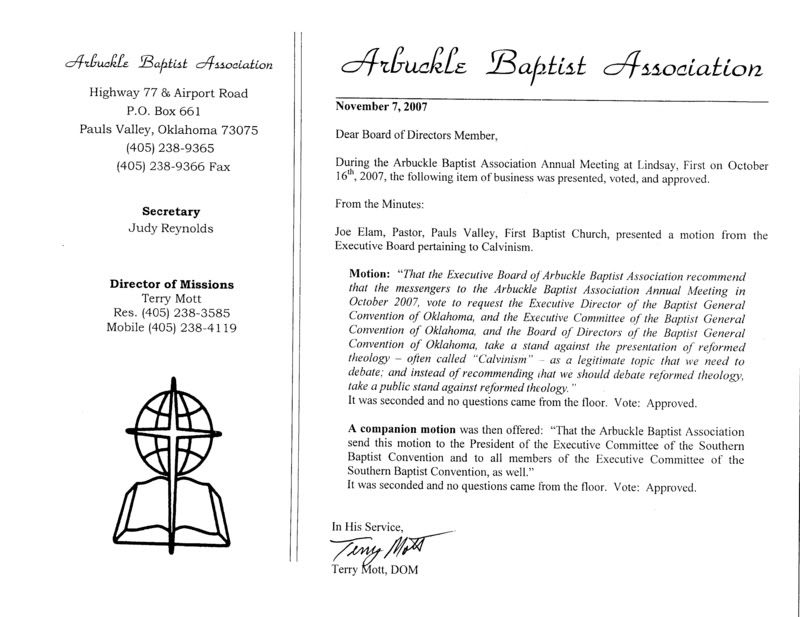
Calvinism is a Fad that Should NOT be Debated or Taken Seriously

This letter below is exactly why the Building Bridges conference is so important. I am amazed at the intensity of the ignorance that must have been involved in writing that letter. And my statement that I just made is the perfect example of why the conference is needed - because what I wrote is what I feel. And hopefully this conference will put an end to those that incite this type of anger in Calvinists - and those like me that are willing to fire back.

Click here to see it in a more readable format.


HT: Founders / Tom Ascol

Book Review: Covenant and Salvation:Union with Christ


Staff Review: Covenant and Salvation: Union with Christ


Covenant and SalvationAuthor: Michael Horton

Publisher: Presbyterian

ISBN: 9780664231637

Paperback, 324 pages


As the third volume of Horton’s series on covenant theology, this volume is perhaps of special interest because it is most clearly focused on issues surrounding soteriology – issues such as law and gospel, imputation, justification, union with Christ, ordo solutis, etc. Consistent with the rest of the series, Horton seeks to develop the implications of a classic Reformed understanding of covenant with reference to these issues and in conversation with various modern streams of thought. I found this format engaging and educational, and appreciated many of his insights, especially in regard to imputation, law and gospel, and glorification. However, I thought his presentation of union with Christ and justification could have been nuanced further so as to do justice to its use in Calvin and Reformed theology.


Horton’s thesis in this regard is that “justification is exclusively juridical, yet it is the forensic origin of our union with Christ, from which all of our covenantal blessings flow.” (139) What is perplexing in this is not the forensic nature of justification but his insistence that justification is the ground of union with Christ rather than union with Christ being the ground of both the forensic and renovative benefits of salvation. The motivation for this insistence is laudable – to keep justification from being grounded in any way in ontological or moral changes in us. Horton seems to identify the concept of “union with Christ” solely with these renovative, progressive aspects of our salvation, and thus denies that it can be logically prior to forensic justification.


That way of speaking of “union with Christ” is surely current in some circles both now and in the past. But it does not seem necessary or accurate to understand the Reformed use of “union with Christ” in solely renovative terms. In fact, I would suggest, to do so is to miss the particular genius of Calvin’s logic concerning the distinction and inseparability of the forensic and renovative benefits of salvation. Calvin, typically, in answering the charge that a purely forensic justification would make the real renovation of life unnecessary, explained the necessity of both because of their inseparability in the person of Christ, to whom we are united by faith. The logic is this: Do you have justification? It is only because you are united to Christ by faith — and if you are united to Christ, you have sanctification too, for both are in Christ and Christ can not be torn apart. Some of the quotes Horton cites are themselves clear statements of this line of thought. For instance, he quotes Calvin:


Although we may distinguish them [justification and sanctification], Christ contains both of them inseparably in himself. Do you wish, then, to attain righteousness in Christ? You must first possess Christ; but you cannot possess him without being made partaker in his sanctification, because he cannot be divided into pieces [1 Cor. 1:13]. Since, therefore, it is solely by expending himself that the Lord gives us these benefits to enjoy, he bestows both of them at the same time, the one never without the other. Thus it is clear how true it is that we are justified not without works yet not through works, since in our sharing in Christ, which justifies us, sanctification is just as much included as righteousness. (Insitutes, 3.16.1)


Horton’s conclusion on the basis of this quote is, “Calvin recognizes here that justification need not be confused with sanctification by means of an all-encompassing ontology of union in order to recognize the inseparability of both legal (forensic) and organic (effective) aspects of that union” (emphasis his). Now, it may be true that Calvin would object to an ontological concept of union with Christ, but the problem would not be that it is “all-encompassing” of “legal” and “organic” aspects of salvation. In fact, the very key to his logic here is the logical subordinance of both justification and sanctification to union with Christ. Read more…

Friday, November 9, 2007

Dressing Down the Pulpit - Culture vs Cool

This is an excellent must read article from Pastor Mike Mckinney at 9Marks. It is as funny as it is true and relevant, and I don't mean relevant in a cool kind of mirroring the culture way.

Show me a grown man with a goatee and I’ll show you a major league baseball player. Show me a grown man with a goatee wearing sandals and I’ll show you a youth pastor.

When I was a kid, I remember that the youth pastor at our church was totally different than any other pastor I’d ever seen. He quoted rock bands and wore blue jeans to church. He was cool in a way that the other adults in my life were not. I was proud to invite my friends to church and see their negative stereotypes of Christians get blown up. The youth group thrived and "unchurched" kids were reached. The one thing that distinguished our group from others was that our pastor was cool.

As the youth pastors and youth of the 1990s become the head pastors and congregants of the 2000s, it seems like the phenomenon has only grown. It is now an unexamined assumption in many quarters: the best way to reach people is to be like them. In order to reach our culture, we must embody what the culture defines as acceptable and valuable. We must be as "cool" as we can possibly be while still retaining the gospel. That way, people will see us and not be turned off by us. Maybe they’ll even want to be us.

For full article click here.

Signs of the Apocolypse: Willow Creek

Willow Creek Repents?

Why the most influential church in America now says "We made a mistake."
Few would disagree that Willow Creek Community Church has been one of the most influential churches in America over the last thirty years. Willow, through its association, has promoted a vision of church that is big, programmatic, and comprehensive. This vision has been heavily influenced by the methods of secular business. James Twitchell, in his new book Shopping for God, reports that outside Bill Hybels’ office hangs a poster that says: “What is our business? Who is our customer? What does the customer consider value?” Directly or indirectly, this philosophy of ministry—church should be a big box with programs for people at every level of spiritual maturity to consume and engage—has impacted every evangelical church in the country.


So what happens when leaders of Willow Creek stand up and say, “We made a mistake”?


Signs of the Apocolypse: Hagee Hersey Full Live and in Color

Pastor John Hagee is now boldly & openly proclaiming that Jesus Christ was not the Messiah (the Christ)! Since Hagee is deeply involved with the current Illuminist leadership of Israel, this is mostly likely one of the final moves to deceive his followers (& whoever else will listen) into supporting the coming false messiah (Antichrist).

In order to establish a solid foundation for this teaching the first part will be devoted to proving that modern day Israel is being totally controlled by Cabalistic Illuminists. An accurate description of these devils would be Revelation 3:9: 'I will make them of the synagogue of Satan, which say they are Jews, and are not, but do lie.' The second part of this teaching will be devoted to refuting Hagee's new book (In Defense of Israel), in which he relentlessly twists Scripture in order to deceive his readers.

The net effect is a perversion of the Gospel of Jesus Christ. Some exact quotes from this book read: 'Jesus refused to produce a sign ? because it was not the Father's will, nor his, to be Messiah'. (p 138) 'The Jews were not rejecting Jesus as Messiah; it was Jesus who was refusing to be the Messiah to the Jews.' (p. 140) 'They wanted him to be their Messiah, but he flatly refused.' (p. 141) 'Jesus rejected to the last detail the role of Messiah in word or deed.' (p. 145) Hagee's own writings condemn him, especially in light of: 1 John 2:22: Who is a liar but he that denieth that Jesus is the Christ? He is antichrist...' - Quoted from Dr. Scott Johnson

Click here to hear a sermon from Dr. Scott Johnson detailing Hagees Heresy. You may also watch the video below.

I am Offended by Family Christian Book Stores

I couldn't beleive the subject line of the email Family Christian recently sent me. The reason being, was the content of the email. The subject line said "Strengthen your life in Christ with these great books". I then opened the email to be throughly disgusted by their choices.


See Below:


If you really want to stregthen your walk and your life in Christ go here:
http://www.monergismbooks.com/
http://www.wtsbooks.com/


Thursday, November 1, 2007

Back To School

This is the first paper I turned in at California Baptist University

EVOLUTION VS. CREATION

You don’t have to disengage your mind to believe that this world is here by God’s divine act of creation. Christians do not have to hide from science believing that they need to exercise some blind faith in something that makes no sense in the physical world. In fact now the Christian point of view is the one that has science on its side. To not understand this is to show that you do not understand what real faith means. We will see that it is now the evolutionary scientists who no longer have a “leg to stand on” so to speak.

To illustrate this, think about your cell phone. It probably has a case and some kind of screen. It also has buttons that you use to control it. What if I were to tell you that all of the individual parts of your phone were made, put into a bag, that bag was shaken and after a certain amount of time those parts came together and become a phone. Would you believe me? Evolutionists would have you believe something far more outrageous than that.


Today I want to engage your minds. I don’t want to talk about the emotional side of the argument, just separate the fact from the fiction and only look at what is true. As we look at these things we will see that the intellectuals are no longer the ones that have science on their side.

During the time that Darwin first expounded his theories; the facts of science were very limited. At this time, it appeared that one celled organisms seemed to spontaneously grow and cells appeared to be nothing more than blobs of gelatin. We did not even fully understand how the eye worked. We would say these things are black boxes, meaning that as Darwin looked at these things he did not understand how they worked. He accepted that the eye worked but at that time they had no idea how. That is what we mean by black box. As science discovered how these things worked, like the cell or the eyes, we see that it is not reasonable for us to even think that these things happened by random chance. In fact we will see that the more we learn, the more organized and deliberate this world really is.

Today I will demonstrate that the facts show us that creation is the only possible explanation.

DEALING WITH THE TWO TITLES: Creationist vs. Evolutionist

As we look at the two sides to this there are two major lies that most people believe.

The first is that evolutionists don’t believe in creation.

This is a false belief. Even the evolutionist believes that there is a start therefore he does believe that this universe is created. What is in question is the source of creation and the motivating factor behind it. Physics even has a law for this. It is the law of cause and effect. Something can only be created by something equal to or greater than itself. The prevalent theory on the beginning of the universe by evolutionists is the big bang theory. The big bang theory states that there was a large expanse from nothing to the universe. That set the stage for the beginning of life on earth. The start of life is based on the theory that a bolt of lightning hit the ocean or that cosmic dust came together in random form and the first living cell was created by random chance. Random chance is then the driving force behind creation for the evolutionist. Therefore, evolutionists believe that creation was by some random chance.

Conversely, lie number two is that creationists don’t believe in evolution.

But evolution is a fact. What needs to be clarified is that there are two types of evolution. The most common understanding of evolution is that life came from random chance, as evolutionists believe and as we said above that life started by some random chance. This also leads us to the theory that one species evolved into another. This is the theory of evolution between species. Christians do not believe this to be true.

The less common known type of evolution which is supported by facts is linear or micro evolution. This is an evolution in which slight variations are seen in a species and stay within that species. There are no transitions from one species to another. There are changes within the population of any species but to what avail. It begs the question


“Is that change for better or worse?”

BIOLOGY AND THE BEGINNING

Examples of irreducible complexity support creation. What that means is that within the biological world we can observe many different types of systems that are designed to support life. These are a big part of Darwin’s black boxes. We will look at a couple of different systems and we have to realize that Darwin did not at that time have any understanding of how they worked.

The flagellum of the bacteria could not exist without all of the individual components. It has a stator, a rotor and is controlled by electrical impulses. It is a tiny electrical motor. Every one of these parts needs to be in place for the flagellum to work. As we have learned in this class all the parts of bacteria need to be in place all at once for that cell to live. There is no way that bacteria could live or the flagellum work without all of those processes in place and functional.

Other biological systems support this also. Photosynthesis in a cell could not take place until all of the components are present. Cellular mitosis could not take place unless all of the organelles are present and functioning properly. The deeper we go, the more systems that we see and how they work, the more we see that if we remove one small component the only thing that we have is a dead, non-functioning cell. From this standpoint, creation is the only possible answer.


Embryology also shows us that creation is the only answer. The evolutionist uses this to try to further his case but to no avail. Recapitulation is a theory that has been set forth to try and promote the evolutionary process. This is one of Darwin’s black boxes. Today we know that every step that a human embryo goes through is human with a human intent. This could only be true if there was intent in creation and intent in creation means that there had to be a creator.


PHYSICS FROM THE BEGINNING

Evolution goes against the laws established by physics.

The first law of thermodynamics states that energy can neither be created nor destroyed by ordinary processes. Energy can, however, change form-for example, from chemical energy to the energy of heat and movement. The second law of thermodynamics states that when energy is converted from one form to another, the amount of useful energy decreases. What we see here is that energy cannot be created or destroyed but it can be consumed. This shows us that the planet is dying off, first, from a loss energy and second, that everything that is created progresses from a state of order to disorder. This is known as entropy. Anything that is left to itself is decaying and dying. Everything is progressing from order to disorder. If everything progresses from order to disorder, according to the first two laws of thermodynamics, then the evolutionary process which states that living cells went from order to a higher order is impossible. There is no possibility for the evolutionary process to take place in this system. We would have to say that the laws of physics that we know today could not be in place for creation to take place.

The law of cause and effect says if anything is created, it is created by something equal to or greater than itself. This being true we would have to say that a one- celled animal could not create a human. This is impossible and again creation is the best alternative.

CONCLUSION

There is no biological system in place at this time that could survive without all of its components being present. The more we look into that the more we see the complexity of living cells and organisms. The only logical conclusion that we can come to is that biologically evolution is not a viable solution.

The first two laws of thermodynamics and the law of cause and effect are completely ignored when using the evolutionary theory. Before using that theory we would then have to change those laws of physics. This would be impossible because those laws define the world that we live in and are valid in every application. We would therefore have to conclude that evolution is once again not a viable theory according to physics.

If these things are so obvious than why do people insist upon the evolutionary theory actually being a fact? The evolution and creation debate draws lines between Christians and non-Christians most of the time. This should as Christians, give us great concern about the motives behind evolutionists and their theory. It is easy to see when you step back and look at it that the evolutionary theory is an attack on the very foundation of the Bible. It is an attempt to virtually kill God or disprove His existence. Men throughout the span of time have always tried to get out from under the authority of God. As Christians let’s make no mistake and defend the biblical truth that God created the heavens and the earth and it took six days, six consecutive twenty-four hour periods. Since we see this debate between Christians and non-Christians we need to understand the fundamental problem. That problem has nothing to do with people believing in evolution, the problem is they are lost without God. Our main focus should be to lead them to Christ and change their entire life.

Wednesday, September 26, 2007

On Sabbatical

I will be returning soon to fight the fight (or at least write about it).

Friday, August 31, 2007

Video: Don't Contextualize the Gospel

Watch John Piper talk about how the basics of the Gospel are understandable across cultures without contextualization (4 min).

Monday, August 27, 2007

Michael Vick has Found Jesus?!?!

Hmmm, I hate to questions his sincerity, but...

Click here to see the video.

Wednesday, August 22, 2007

Funny


Tuesday, August 14, 2007

Reasons 18 to 22 Year Olds Drop Out of Church

A new study from LifeWay Research reveals that more than two-thirds of young adults who attend a Protestant church for at least a year in high school will stop attending church regularly for at least a year between the ages of 18 and 22.

As young people transition from high school into the workforce or college life, they are faced with many choices – including whether to continue attending church. Although this decision is a source of concern for parents and church leaders, discussion of the reasons young adults choose the direction they do has largely been speculative.

"Lots of alarming numbers have been tossed around regarding church dropouts," said Ed Stetzer, director of LifeWay Research, the research arm of LifeWay Christian Resources of the Southern Baptist Convention. "We wanted to get at the real situation with clear research – and there is some bad news here, no question. But, there are also some important solutions to be found in the research. When we know why people drop out, we can address how to help better connect them."

To uncover the reasons young people leave church, LifeWay Research conducted a survey in April and May 2007 of more than 1,000 adults ages 18-30. Each indicated that they had attended a Protestant church regularly for at least a year in high school.

Click here for full article.

If Election is True, Why Should We Evangelize?

When speaking on predestination and election, there is one question that regularly presents itself:
If God in His sovereignty has settled from all eternity who shall be saved, why should we evangelize? God is sovereign not only in the dispersion of His grace but also in His commands for the church. The first thing we must understand is that we are commanded to evangelize. Part of God's divine decree is not only to decree who will be saved but how they will be saved, and he has declared that the elect will be saved through preaching. Let us think hard about the missionary enterprise and the privilege of our involvement in it that it may be said of us, how beautiful are the feet of those who send the preachers so that people may hear, believe, and be saved.

Click here for more.

God's Sovereignty and the Atonement

Without a doubt, a firm grasp of the sovereign rule of our Father in heaven is necessary for a God-honoring Christian life and effective witness of the risen Lord. When we understand that God is Lord over all things we can find peace even in the most difficult of circumstances because we know that nothing takes God by surprise, and, therefore, everything that happens is for the good of His people and His glory (Rom. 8:28). Knowing that God is sovereign in salvation makes us confident that our witness to the Gospel will not be in vain and emboldens us to take great risks for the kingdom. We learn to act without worrying overtly about our initial success or failure, for it is God, working through flawed men and women, who saves His people.

In a similar vein, our Christian life and witness is impossible if we do not understand what took place during Jesus’ crucifixion. The Savior’s atonement for sin on the cross is the good news of the Gospel, for in Jesus the Father was reconciling the world to Himself (2 Cor. 5:19). Gaining a fuller grasp of Christ’s work enables us to present Him to others with clarity and helps to increase our assurance that He is indeed “the way and the truth and the life” (John 14:6).

Unfortunately, church leaders often neglect the full exposition of these topics and assume that Christians know enough about the atonement and God’s sovereignty. Today, a good understanding of such things is no longer a given. There are people in our pews who have not tasted the riches of the cross and the Lord’s all-encompassing reign.

Click here for more.

Christians Move Towards Code on Seeking Converts

Christians move towards code on seeking converts
by Robert Evans
Reuters

GENEVA (Reuters) - Christian churches are moving closer to a common code of conduct on how they go about winning converts among themselves and from other religions, the World Council of Churches (WCC) said on Monday.

Conversion, sometimes dubbed "sheep-stealing" as it targets another's flock, is a cause of friction and conflict between religions and among different branches of individual faiths.

Militant groups are often accused of underhand tactics in winning over new adherents.

The Geneva-based WCC, working with the Vatican on the issue, said a meeting in Toulouse later this week should bring the year-long process of agreeing a conversion rule-book nearer to completion by its target date of 2009.

"Evangelical and Pentecostal representatives will be taking part in the dialogue for the first time, and we see this as a good sign for the eventual success of this project," said WCC spokesman Juan Michel....

The first meeting was attended -- alongside the Christians -- by representatives of the Buddhist, Hindu, Muslim, Jewish and Yoruba faiths.

Bring the Youth - Oh Wait, Don't!!!!!

The National Youth Workers Convention will take place in three different US cities this coming fall (October through November). The event is presented by Youth Specialties, an organization that has been a springboard for contemplative and emerging spiritualities for many years. If your youth pastor or youth workers are planning on attending one of the three conventions, we urge you to take a look at the following links (from the NYWC website). We think you will agree that attendees will receive a hearty dose of mystical spirituality and emergent messages that can ultimately lead followers away from biblical faith:Labyrinths,Taize worship, Catholic liturgy, meditation - it's all at the 2007 National Youth Workers Convention

Sunday, August 12, 2007

High Hopes

I will be honest when I first saw this advertisement on Southern Baptists and Calvinsim I didn't know what to think. But as I read further this could be a good thing for the SBC. I was impressed that Southeastern Seminary and the Founders ministry are putting the two day conference on.

Click here for the advertisement

Monday, August 6, 2007

How Much Wrath does God Have?

The Scriptures use various terms to express God’s emotions that are in contrast to his love for, pleasure in, and satisfaction with his people. In the Old Testament at least six terms are used to express his negative reactions to humanity, particularly to his covenant people. These terms, all of which express varied shades or degrees of wrath, anger, displeasure, or vexation, are the following: ˒aph (to be angry), zā˓aph and derivatives (to be wroth, displeased, sad); ḥêmâḥêmâh (indignation, anger, wrath); kâ˓as (to be angry, wrathful, indignant, vexed, grieved); ˓ebrâh (rage, wrath); qâsaph (to be displeased, angry, wroth); ˒saneh (to hate). In the New Testament there are more than twenty references to the anger, wrath, or vengeance (orgē) of God and a few references to indignation and displeasure (achthŏs). These terms are to be considered anthropopathic expressions; human terms, however, cannot give the full meaning of the infinite and sovereign God’s emotional experiences. As his love is infinitely incomprehensible, so are his displeasure, hate, anger, wrath, and vengeance. There is good reason indeed for the writer to the Hebrews to warn sinful people that it “is a dreadful thing to fall into the hands of the living God” (Heb. 10:31).

Sunday, August 5, 2007

23 Facts About God

1. God is self-existent. Exod. 3:13-14
2. God is self-sufficient. Ps. 50:10-12
3. God is eternal. Deut. 33:27; Ps. 90:2
4. God is infinite. 1 Kings 8:22-27; Jer. 23:24
5. God is omnipresent. Ps. 139:7-12
6. God is omnipotent. Gen. 18:14;Rev. 19:6
7. God is omniscient. Ps. 139:2-6; Isa. 40:13-14
8. God is wise. Prov. 3:19; 1 Tim. 1:17
9. God is immutable. Heb. 1:10-12; 13:8
10. God is sovereign. Isa. 46:9-11
11. God is incomprehensible. Job 11:7-19; Rom. 11:33
12. God is holy. Lev. 19:2; 1 Pet. 1:15
13. God is righteous and just. Ps. 119:137
14. God is true. John 17:3; Titus 1:1-2
15. God is faithful. Deut. 7:9; Ps. 89:1-2
16. God is light. James 1:17; 1 John 1:5
17. God is good. Ps. 107:8
18. God is merciful. Ps. 103:8-17
19. God is gracious. Ps. 111:4; 1 Pet. 5:10
20. God is love. John 3:16; Rom. 5:8
21. God is spirit. John 4:24
22. God is one. Deut. 6:4-5; Isa. 44:6-8
23. God is a Trinity. Matt. 28:19; 2 Cor. 13:14


How Good is Our God!

This sovereign redemptive love is one facet of the quality that Scripture calls God’s goodness (Ps. 100:5; Mark 10:18), that is, the glorious kindness and generosity that touches all his creatures (Ps. 145:9, 15-16) and that ought to lead all sinners to repentance (Rom. 2:4). Other aspects of this goodness are the mercy or compassion or pity that shows kindness to persons in distress by rescuing them out of trouble (Pss. 107, 136) and the long-suffering, forbearance, and slowness to anger that continues to show kindness toward persons who have persisted in sinning (Exod. 34:6; Ps. 78:38; John 3:10–4:11; Rom. 9:22; 2 Pet. 3:9). The supreme expression of God’s goodness is still, however, the amazing grace and inexpressible love that shows kindness by saving sinners who deserve only condemnation: saving them, moreover, at the tremendous cost of Christ’s death on Calvary (Rom. 3:22-24; 5:5-8; 8:32-39; Eph. 2:1-10; 3:14-18; 5:25-27).

Let the Redeemed of the Lord Say So

Let the Redeemed of the Lord Say So

Psalm 107
Oh give thanks to the Lord, for he is good,
for his steadfast love endures forever!
2 Let the redeemed of the Lord say so,
whom he has redeemed from trouble
3 and gathered in from the lands,
from the east and from the west,
from the north and from the south.
4 Some wandered in desert wastes,
finding no way to a city to dwell in;
5 hungry and thirsty,
their soul fainted within them.
6 Then they cried to the Lord in their trouble,
and he delivered them from their distress.
7 He led them by a straight way
till they reached a city to dwell in.
8 Let them thank the Lord for his steadfast love,
for his wondrous works to the children of men!
9 For he satisfies the longing soul,
and the hungry soul he fills with good things.
(ESV)

Sunday, July 29, 2007

Prayer Needed

Please pray for this family, this was a family that attended the church I came from in California.

(CBS) CORONA, Calif. Authorities Sunday identified the victim of a fatal hit-and-run collision in Corona as a Murrieta woman, whose children and husband were also injured in the crash.

Helen Sexsmith, 48, of Murrieta was a passenger in a minivan struck by a 1998 four-door Saturn at 4 p.m. Saturday at Lincoln Avenue and Railroad Street. The collision caused the minivan to roll onto its side and hit a signal pole, according to a press release from the Riverside County Sheriff's Department.

The driver of the Saturn ran away and has not been found, according to the statement.

Sexsmith was rushed in Corona Regional Medical Center, where she died a short time after the crash, according to the statement.

Sexsmith's husband was the driver of the minivan that also carried their three children. They were transported to Riverside Community Hospital with minor injuries and were released, according to the statement.

Monday, July 23, 2007

We are All so Cool and Individualistic - Yeah Right

Sociologists call this the era of hyper-individualism – and with good reason, according to our latest report. Interviews with more than 4000 adults show that we generally see ourselves as independent thinkers, loyal and reliable, and making a positive difference in the world. We support traditional family values but we are open to considering new moral perspectives. And while our faith is very important in our lives, it may not be very influential in our decision-making. Find out more about how we see ourselves, and the implications of that self-view by reading the new Barna Update that is on our website. www.barna.org

Sunday, July 22, 2007

The Most Precious thing in Heaven or Earth

The most precious thing in heaven or earth(John Flavel, "The Fountain of Life" 1671)In giving Christ to die for poor sinners, God gave the richest jewel in His cabinet; a mercy of the greatest worth, and most inestimable value.

Heaven itself is not so valuable and precious as Christ is! Ten thousand thousand worlds--as many worlds as angels can number, would not outweigh Christ's love, excellency and sweetness! O what a lovely One! What an excellent, beautiful, ravishing One--is Christ!

Put the beauty of ten thousand paradises, like the garden of Eden, into one; put all flowers, all fragrances, all colors, all tastes, all joys, all sweetness, all loveliness into one; O what a lovely and excellent thing would that be! And yet it would be less to that loveliest and dearest well-beloved Christ--than one drop of rain to all the seas, rivers, lakes, and fountains of ten thousand earths!

Now, for God to bestow the mercy of mercies, the most precious thing in heaven or earth, upon poor sinners; and, as great, as lovely, as excellent as His Son was--what kind of love is this!

One Laptop Per Child = One Porn Account Per Child

As worthy of a program for learning as this may be. It seems they did not realize that given the opportunity for sin and depravity, that these kids would unfortunately gravitate to viewing porn. Maybe some will think it's ok, - no big deal - they will say things like, "when I was a kid my dad had a stack of Playboy magazines under his bed". Well, I have news for you; it wasn't ok then for your father, nor is it ok now for you or any child/kid/teen etc.

By far, the most searched for terms on the internet are related to pornography. Pornography is rampant in the world today. Perhaps more than anything else, Satan has succeeded in twisting and perverting sex. He has taken what is good and right (loving sex between a husband and wife) and replaced it with lust, pornography, adultery, rape, and homosexuality. Pornography is simply the first step on a very slippery slope of ever-increasing wickedness and immorality (Romans 6:19). Just as a drug user is led to consume greater and more powerful quantities of drugs, so pornography drags a person into hard-core sexual addictions and ungodly desires.

The three main categories of sin are: the lust of the flesh, the lust of the eyes, and the pride of life (1 John 2:16). Pornography definitely causes us to lust after flesh, and it undeniably is a lust for our eyes. Pornography definitely does not qualify as one of the things we are to think about, “Finally, brothers, whatever is true, whatever is noble, whatever is right, whatever is pure, whatever is lovely, whatever is admirable - if anything is excellent or praiseworthy - think about such things” (Philippians 4:8). Pornography is addictive (1 Corinthians 6:12; 2 Peter 2:19), destructive (Proverbs 6:25-28; Ezekiel 20:30; Ephesians 4:19), and leads to ever-increasing wickedness (Romans 6:19). Lusting after other people in our minds (the essence of pornography) is offensive to God (Matthew 5:28). When habitual devotion to pornography characterizes a person’s being, that demonstrates the person is not saved (1 Corinthians 6:9).


ABUJA (Reuters) - Nigerian schoolchildren who received laptops from a U.S. aid organization have used them to explore pornographic sites on the Internet, the official News Agency of Nigeria (NAN) reported Thursday.

NAN said its reporter had seen pornographic images stored on several of the children's laptops.

"Efforts to promote learning with laptops in a primary school in Abuja have gone awry as the pupils freely browse adult sites with explicit sexual materials," NAN said.

A representative of the One Laptop Per Child aid group was quoted as saying that the computers, part of a pilot scheme, would now be fitted with filters.

Saturday, July 21, 2007

Songs of the Lukewarm Church

1. Blest Be The Tie That Doesn't Cramp My Style
2. Pillow of Ages, Fluffed for Me
3. I Surrender Some
4. I'm Fairly Certain That My Redeemer Lives
5. Sit Up, Sit Up For Jesus
6. Take My Life and Let Me Be
7. What An Acquaintance We Have In Jesus
8. Where He Leads Me, I Will Consider Following
9. He's Quite a Bit To Me
10. Oh, How I Like Jesus
11. Fill My Spoon, Lord
12. It Is My Secret What God Can Do

HT: Kirk Cameron

Signs of the Apocolypse: Japan

The depravity of man never ceases to amaze me - let me stop. This time it did.

I am not going to link to the story out of fear someone may actually go and order one.

The Lord saw that the wickedness of man was great in the earth, and that every intention of the thoughts of his heart was only evil continually. Genesis 6:5

Article:

One japanese man has spent $170,000 to build an army of nearly a hundred ultra-realistic sex dolls made by Orient Industry. Apparently he's part of the fever taking over middle-aged Japan men, who buy these $850 to $5,500 silicon zombies with 35 movable joints out of desperation.

Signs of the Apostate! - Des Moines

While reading the newspaper I saw an ad for a local church that caught my eye. Upon reading the ad I could not believe their statements - it was truly unbelievable. They have what they call a "New Church Model". They actually do have the nerve to call themselves Christian, while touting there are many ways to God. Actually there are two - one leads to hell, the other to heaven. Apparently their denominational ties are to American Baptist.

Here is their "New Church Model":

Wellspring Community Church is committed to learning how to engage a gospel that calls us to prayer with openness, to act on behalf of social justice and to speak on behalf of those who cannot speak in our world, If you are looking for a place to explore your spirituality, where questions are honored and answers are open for conversation then Wellspring may be worth a visit to you.

Following are some distinctives that make Wellspring Community Church a new church model:

There is no building program; our by-laws state we will not own real estate. We choose to put our resources of time and money, not into maintaining a building, but into action. We meet in a nice rented space. By renting we can expand or contract as needed.

We are a church without walls. For us this means we desire to create a community that is fluid. We meet on Sunday mornings to worship but do not have regular mid-week programs. The function of worship is to share our stories, renew our hope and vision for life and then to live into our understanding of faith in the community at large.

We foster a global perspective of our world. We sponsor a refugee family from Afghanistan. We support several community ministries, which include serving meals at Children and Family Urban Ministries and an after school program for Adolescent girls called the WILD Girls. Several members are actively involved in community service projects and tutoring.

Spiritual formation is regarded as both an individual and community act.....to think individually within the context of a diverse community encourages a spirituality that is neither self-centered nor devoid of self.

We are an inclusive community, which means that everyone is invited into the circle to share and engage in the conversation of the community. We work to honor diversity in the words we use, the manner in which we worship, and the songs we sing. Being a Christian community, we see Christ’s teaching of love and compassion as our guideline. As Christ saw the holy in each of us we honor each person’s story: from children through adult.

For some other apostate, heretical statements from this "church" click here.

Tuesday, July 17, 2007

Blinging for Jesus - Where's yours?

My God is a God who wants me to have things. He wants me to bling! He wants me to be the hottest thing on the block”. “God’s will for us is to be successful.” That’s a sample of the mission statements of a well known entertainer and local purveyor of the prosperity gospel. Both claim to define what God’s mission is and thus by extension what the church’s mission should be. Yet, what is the church’s mission?

For full article click here.

Sunday, July 15, 2007

The First Way to Hell, Discovered

From - The Works of John Flavel Volume 3 - Pneumatologia: A Treatise of the Soul of Man (Continued) Section 4 - Of the Human Soul More Valuable than the Whole World: Its Blessedness when Saved, it’s Irreparable Ruin when lost:

Matthew 16:26 For what is a man profited, if he shall gain the whole world and lose his own soul? Or what shall a man give an exchange for his soul?

[This is the first paragraph introducing this section on page 153_ ed]

DIFFICULT duties need to be enforced with powerful arguments. In the 24th verse of this chapter, our Lord presseth upon his disciples the deepest and hardest duties of self-denial, acquaints them upon what terms they must be admitted into his service: "If any man will come after me, let him deny himself, and take up his cross and follow me."

[This is the first of 12 ways to hell and remedies thereof by Mr. Flavel as found on pages 183 through 225 _ ed]

Click here for more from John Flavel on "The first way to hell, discovered."

Belgic Confession Article 37: The Last Judgment

Article 37: The Last Judgment

Finally we believe, according to God's Word, that when the time appointed by the Lord is come (which is unknown to all creatures) and the number of the elect is complete, our Lord Jesus Christ will come from heaven, bodily and visibly, as he ascended, with great glory and majesty, to declare himself the judge of the living and the dead. He will burn this old world, in fire and flame, in order to cleanse it.

Then all human creatures will appear in person before the great judge-- men, women, and children, who have lived from the beginning until the end of the world.

They will be summoned there by the voice of the archangel and by the sound of the divine trumpet.^79

For all those who died before that time will be raised from the earth, their spirits being joined and united with their own bodies in which they lived. And as for those who are still alive, they will not die like the others but will be changed "in the twinkling of an eye" from "corruptible to incorruptible."^80

Then "the books" (that is, the consciences) will be opened, and the dead will be judged according to the things they did in the world,^81 whether good or evil. Indeed, all people will give account of all the idle words they have spoken,^82 which the world regards as only playing games. And then the secrets and hypocrisies of men will be publicly uncovered in the sight of all.

Therefore, with good reason the thought of this judgment is horrible and dreadful to wicked and evil people. But it is very pleasant and a great comfort to the righteous and elect, since their total redemption will then be accomplished. They will then receive the fruits of their labor and of the trouble they have suffered; their innocence will be openly recognized by all; and they will see the terrible vengeance that God will bring on the evil ones who tyrannized, oppressed, and tormented them in this world.

The evil ones will be convicted by the witness of their own consciences, and shall be made immortal-- but only to be tormented in the everlasting fire prepared for the devil and his angels.^83

In contrast, the faithful and elect will be crowned with glory and honor. The Son of God will "confess their names"^84 before God his Father and the holy and elect angels; all tears will be "wiped from their eyes";^85 and their cause-- at present condemned as heretical and evil by many judges and civil officers-- will be acknowledged as the "cause of the Son of God."

And as a gracious reward the Lord will make them possess a glory such as the heart of man could never imagine.

So we look forward to that great day with longing in order to enjoy fully the promises of God in Christ Jesus, our Lord.

^79 1 Thess. 4:16 ^80 1 Cor. 15:51-53 ^81 Rev. 20:12 ^82 Matt. 12:36 ^83 Matt. 25:14 ^84 Matt. 10:32 ^85 Rev. 7:17

Mom's Realize it is Better to be at Home than Working


In the span of the past decade, full-time work outside the home has lost some of its appeal to mothers. This trend holds both for mothers who have such jobs and those who don't.

Among working mothers with minor children (ages 17 and under), just one-in-five (21%) say full-time work is the ideal situation for them, down from the 32% who said this back in 1997, according to a new Pew Research Center survey. Fully six-in-ten (up from 48% in 1997) of today's working mothers say part-time work would be their ideal, and another one-in-five (19%) say she would prefer not working at all outside the home.

There's been a similar shift in preferences among at-home mothers with minor children. Today just 16% of these mothers say their ideal situation would be to work full time outside the home, down from the 24% who felt that way in 1997. Nearly half (48%) of all at-home moms now say that not working at all outside the home is the ideal situation for them, up from the 39% who felt that way in 1997.

Do We Stand Before God in Judgment Upon Death or Later?

We have to make a distinction, as I think the Bible does, between the judgment that we receive immediately upon our death, at which we are brought before Christ, and what the Bible speaks of as the last judgment. There’s a reason the Bible refers to the last judgment as the last. That which is last presupposes that there have been some kinds of judgment prior to it. The Bible says that it’s appointed for man to die once, and then the judgment. I think there’s much in the New Testament to indicate that at the moment we die, we experience at least a preliminary judgment.

Paul, for example, said that he longed to depart and to be with Christ, which was far better than to remain here in this life and in the ministry he had. Historic Christianity has almost universally, but not quite, confessed the idea that the departed saints go immediately to be in the presence of Christ, in what is called the enjoyment of the intermediate state; that is, we are disembodied spirits, and we await the final consummation of the kingdom of Christ, whereby we will experience the resurrection of the body. When, in the Apostles’ Creed, we say, “I believe in the resurrection of the body,” we’re not talking about Christ’s body but about our future resurrected bodies. As I say, 0historic Christianity believes that there is an immediate transference from this world into the presence of Christ, at least in our disembodied spirit state. For that to happen, some kind of judgment has to take place. For example, Paul would not be ushered into the presence of Christ immediately upon his death without Christ first making an evaluation that Paul was indeed one of his—that he was a justified man in a state of salvation. I think there is a preliminary division of the sheep and the goats prior to the final judgment on the last day, of which Scripture speaks. Jesus warns repeatedly of that last judgment.

Very few people in our secular culture find a discussion of judgment to be relevant; it is politically incorrect to judge others or, to some extent, even ourselves—to distinguish between right and wrong, truth and falsehood. Yet these very same people will commend the teachings of Jesus as wise and wonderful. But if Jesus of Nazareth taught anything, he taught repeatedly and emphatically that everyone of us will in fact be brought before the judgment throne of God for a final, consummate judgment.

For an excellent book on this topic click here.

Saturday, July 14, 2007

Mohler and Piper Running for President?


There is apparently an unofficial campaign being waged at Facebook to have Al Mohler and John Piper into the White House. Well, they have my vote.

Wednesday, July 11, 2007

What Is The True Church?

It is no surprise that our society is asking the question what is the true church? An alarming article came out yesterday claiming that the Catholic Church is the true church and all other churches are false and basically on the road leading to hell. Yet again this article proves to be an example of what happens when our sinful society tries to define something apart from the scriptures.
As I looked over this crazy article, I was reminded of what Jesus said in John 14:6 "I am the way, the truth, and the life, no man comes to the Father but by me." You see it is not the Catholic Church or the Pope that is truth and the only way to heaven the Bible clearly says that the entrance is the Lord Jesus Christ. Jesus says in John 3:3 that unless a man is born-again, he will not enter into eternal life. Any church needs to be concerned with endorsing things, methods or beliefs that are not even scriptural. Frankly I am not surprised that the Catholic Church came out with this false statement.

Click here to read article

Monday, July 9, 2007

Who Doesn't Want This Martin Luther T-shirt?


Concern over Southern Baptist Agenda Pushes Group to Seek Common Ground

They’re America’s other Baptists — the ones who appoint women pastors, work with theological liberals and line up more closely with President Jimmy Carter than with President George W. Bush.

Over the last 25 years they have watched with growing concern as their conservative Southern Baptist brethren came to define the religious tradition for the public.

Now these other Baptists, who are spread among many denominations, are pooling resources on humanitarian work and evangelism, hoping they can have a bigger impact.

Friday in Washington, two of the larger groups — the American Baptist Churches and the Cooperative Baptist Fellowship — worshipped together for the first time. They planned to commission two missionary couples who are to represent both groups and will organize a national Islamic-Baptist dialogue to improve relations with Muslims.

“It is an effort to celebrate our common heritages as Baptist Christians and to affirm our commitment to work together more collaboratively,” said the Rev. Daniel Vestal, national coordinator of the Cooperative Baptist Fellowship. “The Baptist witness is much richer and more nuanced than is characterized so often in the public square now.”

In January an even broader group of Baptists will host an Atlanta meeting “to speak and work together to create an authentic and genuine prophetic Baptist voice in these complex times,” according to a joint document they issued called a “North American Baptist Covenant.”

For full article click here.

Third Mark of a Healthy Church MEMBER: Gospel Saturated

The greatest need in the world today is the gospel. It is the greatest need of the world because men, women, and children are perishing without a vital knowledge of God through the good news of his Savior Son Jesus.

The greatest need in the church today is the gospel. The gospel is not only news for a perishing world, it is the message that forms, sustains, and animates the church. Apart from the gospel, the church has nothing to say—nothing to say that cannot be said by some other human agency. The gospel distinguishes the church from the world, defines her message and mission in the world, and steels her people against the fiery darts of the evil one and the false allurements of sin. The gospel is absolutely vital to a vibrant, joyous, persevering, hopeful and healthy Christian and Christian church. So essential is the gospel to the Christian life that we need to be saturated in it in order to be healthy church members.

How then does one immerse oneself in the gospel? What path might lead to greater spiritual health?

Click here for full article.

Contend and Defend

Seems like there’s been quite a hullabaloo over the gospel lately.

A man named Chalke, echoing a McLaren, echoing a Green and a Baker, echoing a number of feminists, used the words "divine child abuse" to talk about the cross. In response, two major British evangelical institutions refused to let Chalke speak, thereby cutting ties with a third institution that has Chalke on its board.

A book called Pierced For Our Transgressions responded to Chalke, which in turn provoked a heavy-weight named Wright to enter the ring, pound the book, and defend Chalke.

The conservative blogosphering bleacher-sitters then jumped to their feet and started quarrelling with one another over whether or not Wright is one of them. Another heavy-weight named Piper now promises to leap in soon with a book that says "no" and argues that Wright is "harmful to the church and to the human soul." Meanwhile, the U.S. counterpart to the British publisher that printed Pierced decided not to touch the book, telling the enquiring yours truly that the book "doesn’t add anything to the conversation."

Those evangelicals. Always squabbling with one another instead of doing the work of the ministry. Isn’t that what this is?

Well, what does Jude mean when he says "to contend for the faith"? What does Peter mean when he says "be on your guard"? What does John mean when he warns a church to not "even greet" false teachers? What does Paul mean when he says to let anyone with an alternative gospel—my goodness—"be eternally condemned"?

Until this world is ended, the gospel will be challenged from places high and low. It will be tweaked and twisted, denounced and denied. And most fundamentally, Christ calls local churches—not seminaries, not presbyteries, not synods, not theologians, not publishers, and not even eJournals—to defend the gospel. It’s the people in the pews and the pulpits whom these apostles address.

Jonathan Leeman

Is Mark Driscoll Now On-board with us? and What About John H. Armstrong?

Q & A

with Pastor Gilley


Thank you for the work you’ve done in recent months regarding
the “Emergent Church.” ...I keep up on your book reviews and to
a lesser extent your newsletter but have wondered about your
thoughts on two men as of late going in what appears to be two
different directions: 1. Mark Driscoll (Mars Hill, Seattle): moving
from the EC to a strong, sounder theological base. 2. John H.
Armstrong (Anglican, Coming Evangelical Crisis): moving from
a foundationalist theological outlook to the looser, nonfoundationalist
EC perspective. SN

Concerning 1) Driscoll takes a strong Reformed theological position
which makes him distinct from the emergent camp. But he
calls himself emerging and his methods and philosophy of ministry
are questionable in some areas. He has not distanced himself
from a number of mystical issues (Roman Catholic mystics
and their practices) and this is troubling. He also is known as the
“cussing pastor” thanks to Donald Miller’s Blue Like Jazz. He is
known to curse in private and from the pulpit and he is often very
crude with his sexual remarks.

2) Armstrong seems to have embraced the New Perspective on
Paul and other troubling fads. He has moved away from his
Reformed base and now attacks, as you know, what he calls
Foundationalism. So he is taking a postmodern approach to
Christianity which at least borders on emergent.
Some believe that Driscoll has changed to the point that he is
now one of us (conservative evangelicals), I am not so sure of
this. Some also believe that Armstrong has not yet left the camp
(I think he has).

At least these are my thoughts.

LifeWay's Fitness Expert Promotes Yoga

LifeWay's Fitness Expert Promotes Yoga
New Age Movement continues to Haunt Southern Baptist Convention
by Bud Press, Director
Christian Research Service

For years, the Southern Baptist Convention (hereinafter SBC) has warned Christians about the dangers of Yoga and the New Age Movement.

The SBC has developed articles, resolutions, and Interfaith Evangelism Belief Bulletins warning against the New Age Movement and Yoga.

LifeWay Christian Stores, a division of the SBC, removed Susan Bordenkircher's Yoga for Christians and Brooke Boon's Holy Yoga from its main online bookstore.

SBC officials have spoken out against Yoga and other forms of the New Age Movement.

For decades, solid, Bible-based Christian apologists and cult-evangelists have warned the body of Christ about Yoga and the New Age Movement.

God's word, the Bible, warns about false teachers, worldly philosophies, strange doctrines, and traditions of men, and commands Christians to avoid them.

But despite the warnings, LifeWay and its own fitness expert, Branda Polk, promotes Yoga and encourages Christians to participate in Yoga classes.

Click here to read this entire article.

Texas Supreme Court Backs Pastor Over His Publicizing of Affair

Saying it would be unconstitutional for judges to interfere in a church’s internal affairs, the Texas Supreme Court on Friday dismissed a lawsuit filed by a woman who was furious that her pastor told church elders and the congregation about her extramarital relationship.

For full article click here.

America & Liberty: Grounded in Christian Worldview

Widespread is the notion among secular thinkers that liberty cannot exist in the context of government established upon Christian principles. A revisionist view of the ideas and forces that led our founders to throw off the shackles of tyranny in these United States is not only pervasive but being propagated with renewed vigor from the purveyors of political correctness. The notion that liberty is the result of enlightenment thinking has all but replaced the reality that is the polar opposite: liberty is actually grounded in the bible.

For full article click here.

Catholics Have Become Mainstream America

Do you remember when Catholics were a distinct segment of America, and many people wondered what to make of them? Those days are long gone, according to our new survey, which shows that Catholics are not only the largest denominational group in the country, but are now part of the social mainstream. We studied 97 facets of the lives of Catholics and compared them to national norms. The outcome is striking - and, in some cases, disturbing.

For full story click here.

Now here is a great get-away spot!

If you live in the Midwest and are looking to take a family vacation someplace let me suggest Branson, Mo and Silver Dollar City. It is a great family atmosphere with a Christian emphasis. I have never been to a place that is so patriotic and loves what America stands for. I am impressed that many of the shows are not afraid to sing about Jesus Christ and His saving from sin.

Your kids like mine will enjoy all of the rides and shows at Silver Dollar City in Branson, Mo. It is great to come to a place for a vacation and not worry about all of the liberal, sinful, anti-godly STUFF that is going on in much of our society.

As they say in Branson all the time God bless the U.S.A.

Saturday, June 30, 2007

He's Correct!-Updated Link

A. W. hits the nail on the head. He addresses the biggest problem in our churches today. What exactly is that? We have people that think they are saved when actually they are not!

Click here to read this excellent devotion

Saturday, June 23, 2007

Reflections on the SBC in 2007

Dr. Daniel Akin shared some thoughts with his students at Southeastern Seminary. I appreciate his gentle spirit and keen insight into the SBC. His thoughts are:

"Having returned home from the annual meeting of the SBC in San Antonio , I again was reminded why I love and appreciate the people called Southern Baptists. We are not perfect to be sure. Sometimes we can be somewhat funny and even a bit strange in how we do business. Still, our love for the Lord Jesus, devotion to the Bible, and passion for the lost makes me glad to be a part of this family. It honors me to serve you and our Convention at Southeastern Seminary.

As I have done in previous years, let me share some reflections on this year’s meeting, where I think we are, and where, by God’s grace, we can go in the days ahead. Know that what follows will chart the future for Southeastern Seminary.

First, I rejoice in the re-election of Frank Page as our Convention president, and the election of Jim Richards and Eric Redmond as 1st and 2nd vice presidents. All three are friends of mine, and they are men for whom I have great respect. I will support each of them this coming year, especially with my prayers.

Second, we saw a renewed commitment to the Lordship of Jesus Christ, the sufficiency of Scripture, our doctrinal commitments, and the priority of the Great Commission both at home and abroad. All Southern Baptist should be able to unite around these great affirmations. Along with my fellow seminary presidents, I believe the Baptist Faith and Message 2000 is a solid theological confession to guide us. It is not an exhaustive statement, but it is a sufficient statement. It, along with the Abstract of Principles, will continue to give theological direction to Southeastern. This is what our convention reaffirmed on Tuesday evening. Barry McCarty, our chief parliamentarian said to me at the airport following the Convention, there was no understanding that this motion was asking our agencies to do anything different than what we had been doing. It was a reaffirmation, not a re-direction. In that context let me say this. Your seminaries are not interested in theological witch hunts. At the same time, we will not be ostriches with our heads in the sand. If we spot a teaching that possesses a danger to our churches or will compromise our ability to fulfill the Great Commission, you can rest assured that we will withstand it with all our might.

Third, Southern Baptists are overwhelmingly a body of cessationist and continualist when it comes to spiritual gifts and their activity today. We are not “charismatics” in any historic sense of that word. This is what the recent LifeWay survey clearly revealed, and I am surprised at a number of shrill responses I have heard. I am personally grateful for the research done in this area by LifeWay under the superb leadership of its president Thom Rainer, and I am disappointed that some have questioned Dr. Rainer’s motives and intentions. I have known Thom for more then ten years, and I know him to be a man of the highest degree of integrity. Now, let me put my theological cards on the table as I did at this convention. I am a continualist, “open but cautious,” when it comes to the activity of spiritual gifts in our day. This has been my position since I began teaching at Criswell College almost twenty years ago. It is also the case that I do not have a private prayer language nor do I believe that one can make a good case for a private prayer language from the biblical text. Still, I must be honest and note that good non-charismatic scholars like D.A. Carson and Darrell Bock believe 1 Corinthians 14 allows for the possibility of such a gift. Therefore, for me and for Southeastern Seminary, the issue will be one of priority and agenda. If someone makes private prayer languages an agenda item, then I will oppose them in the strongest measure. In fact, as I said above, I will withstand any agenda or movement that gets in the way of fulfilling the Great Commission of Christ. Perhaps you wonder how many of our faculty at Southeastern has a private prayer language. The answer is I do not know. I have never asked. It is not an issue with this faculty, and it will not become one.

Fourth, I believe it is clear that Southern Baptists have got to grow in the discipline of thinking theologically and living biblically. Hopefully the new Broadman and Holman work, A Theology for the Church, will help us in this area. I had the honor to edit this book, and it includes contributions from some of the brightest and best in Southern Baptist life. Our own David Nelson, Pete Schemm, John Hammett and Ken Keathley participate in this project. You will also discover that Mark Dever, David Dockery, Timothy George, Al Mohler, Russ Moore, Paige Patterson, Malcom Yarnell, and Greg Thornberry penned significant chapters as well. Southern Baptists cannot afford sit on the sidelines when it comes to good and careful theological reflection. At Southeastern we are committed to loving God with our heart and head. We believe in pursuing the model left to us by the apostle Paul, the great theologian and the great missionary. We believe the best context for doing theology is the Great Commission. The best missionaries are capable theologians, and the best theologians are also passionate missionaries. The two must never be separated. This is absolutely essential for the future health of our denomination.

Theological discussion and debate, carried out in the atmosphere of mutual love and respect, is a good and healthy thing. Indeed, it is vitally necessary for the health and well-being of the church. Southeastern is delighted to partner with LifeWay and the Founder’s Ministry in sponsoring a conference on Calvinism at Ridgecrest on November 26-28. No subject needs more light and less heat than this one. Extreme positions and dispositions need to be exposed, confronted and rejected. Areas of agreement that will show how we can work together for the gospel need to be embraced and affirmed. We are thrilled to host on our campus, October 26-27, what is certainly to be the premier C.S. Lewis conference in America in several decades. We also are glad to sponsor a conference on the Emerging/Emergent Church with participants like Mark Driscoll and Ed Stetzer on September 21-22. I applaud neither Pastor Driscoll’s view on alcohol nor his less than wholesome language. The former is unwise and runs the risk of compromising his witness. The latter is blatantly sinful. However, we need to hear and learn from persons like Mark Driscoll in how to effectively engage an increasingly secular culture with the life changing gospel of Jesus Christ. We can learn from those with whom we do not see eye-to-eye theologically, or practically, (e.g. in everyday decisions of Christian living). I want a well informed and educated student body. I believe it is appropriate to invite to a college or seminary campus those you would not invite to speak or lead in worship when your local church gathers for worship. It seems to me that a clear difference exists between the two.

Fifth, I was delighted we approved a resolution on integrity in ministry but disappointed we did do the same for one on regenerate church membership. Some feared the latter was telling the local church what to do, but a resolution can never do that. Some may think there was some political agenda in the works. However, this is a clear biblical and theological issue all Baptist should be able to affirm. Perhaps the resolution presented needs to be reworded or adjusted, but an emphasis on regenerate church membership needs to be recaptured by our churches. I have personally been saying this for several years now. I will continue to speak to this in the days ahead.

Sixth, it was a joy to welcome Geoff Hammond as the new president of North American Mission Board and to receive their fine report. Southeastern hopes to work side by side with the North American Mission Board in the years to come as we seek to reach North America with the gospel of our Lord Jesus.

Finally, this year’s attendance is a cause for grave concern. In spite of “pre-convention activity,” this was one of the smallest conventions in years. Our annual meeting is also aging, and I include myself having turned 50. A younger generation committed to the goals and convictions of the Conservative Resurgence must be sought out. We must get them involved with what we are doing. They need our wisdom and we need their passion and energy. I pledge to do my part to see this happen. I believe what is happening on our seminary campuses is a very hopeful sign.

God has blessed our Convention beyond what we deserved. He has indeed been gracious and faithful. Now is the time for us to come together as a mighty army equipped and ready to take the gospel to the nations. Time is short. The hour is urgent. Heaven and hell are real and Jesus is the only difference. If you come to Southeastern, if you send your children to Southeastern, know that our challenge will not be, “Should you go to the nations?” Rather, it will be, “why would you not go? You have already received the command to go to the nations by the Lord Jesus Himself.” Southeastern is committed to being a Great Commission Seminary, and a Great Commission seminary is what we will be. I love you and consider it a joy words cannot capture to serve you."

Danny Akin

President

Saturday, June 16, 2007

How Should we Evangelize our Children?

For many believers, fulfilling Christ’s command to make disciples of all nations begins at home—with their children. In fact, few experiences bring greater joy to Christian parents than seeing their children come to faith in Christ.

The process of evangelizing one’s children, however, can be a daunting task. For many parents, the questions are as practical as they are disconcerting: How should I present the gospel to my children? What’s the best approach to take? How do I know if I’m doing it right? Pitfalls, both real and imagined, intimidate virtually every parent who contemplates this responsibility.

On one hand, there’s the danger of leading children to think they are saved when they are not. On the other, there’s the risk of discouraging children who express a genuine desire to follow Christ.

How, then, should we evangelize our children? The answer to this question is not an easy one, but it begins with recognizing and avoiding some of the common pitfalls in child evangelism.

QUOTE:

"On one hand, there’s the danger of
leading children to think they are
saved when they are not. On the
other, there’s the risk of discouraging
children who express a genuine
desire to follow Christ."


Click here for full article.

Is It Possible to Share the Gospel without Offending?

A few years ago, I was involved in training the laity of a local church in the activity we call personal evangelism, and I did that over a period of sixteen weeks. Of that sixteen weeks, about three weeks required training in the content of the message we call the gospel. That was the easy part. The rest of the training was devoted to helping people learn how to communicate their faith in a way that was nonthreatening and noninsulting to people.

People are extremely sensitive about how they’re approached on matters of religion. Many of us who are so excited about our faith in Christ want to share it with everyone we love, and our intentions are good. We care about our friends, and we want them to participate in the joy and discovery of this wonderful thing called salvation. But when we do that, so often we come across to these people as saying, in attitude if not in words, “I’m good and you’re not.” People are turned off by that, and rightly so.

Somebody said once that evangelism, true evangelism, is only this—one beggar telling another beggar how to find bread. There’s nothing that should make me boastful about my faith. I recognize that my faith is a result of the grace of God. And so we must understand that when we’re talking to people, we’re called to be gracious and kind. The fruit of the Spirit that the New Testament calls us to exhibit includes gentleness, meekness, patience, and love. That’s the spirit in which we are called to communicate to people.

Even though we are gracious, kind, patient, friendly, and sensitive to people’s dignity, we cannot remove altogether what the New Testament calls the offense of the gospel because the gospel does call people to repentance, and people are threatened by that. But it is important that we not add unnecessarily to the offense that is built into the message of sin and redemption. Sometimes people reject us and what we say because they’re rejecting Christ—and we suffer unjustly. But many more times people get angry not because they’re offended by Christ but because they’re offended by our insensitivity toward them as people.

Are Fathers Necessary?

Columnist Maureen Dowd of The New York Times drew fire from a variety of people, men and women alike, with her controversial book asking, Are Men Necessary? It’s a good question, but perhaps we should also ask, “Are fathers necessary?” Are men important only for the purpose of procreation, or as fathers do they fulfill an important and overlooked role in the family and society?

The anti-male consortium has its endorsers, and they waste no flattery on the masculine gender. Gloria Steinem once remarked, “A woman without a man is like a fish without a bicycle.” To some, men are little more than an unnecessary commodity. But why this negative view?

Of course, men have not always made the most positive contributions to their collective reputation. Many have backed out of relationships and have given up their responsibility to love, support, discipline and nurture their children. Women have often had to step up to the plate and try to fulfill the roles of both mother and father. Although humans are capable of amazing resilience in the face of difficulty, such situations are obviously far from ideal.

For full article click here.

Mohler to SBC: Southern Committed to Theological Fidelity of Professors

The Southern Baptist Theological Seminary gladly uses the Baptist Faith & Message 2000 as a guide in hiring professors but holds professors to standards that go beyond the BF&M in order to ensure their commitment to God’s truth and their compliance with the wishes of the Southern Baptist Convention, R. Albert Mohler Jr. said June 13 in his report to the SBC in San Antonio.

“In the hiring of a seminary professor you do not want to ask those questions that will mean that we will hire those who merely meet the most basic requirements. If you’re going to hire a seminary professor, you want the one who most comprehensively embraces the truth taught by the Scripture and embraced by this denomination,” Mohler, who serves as president of Southern Seminary, said.

Click here for full article.